Wine goes with food. I know this sounds obvious, but not that long ago I got into a disagreement with a wine blogger about this very subject. Her point was that not all wine needs to be paired with food, some people enjoy wine without food. Well not me. If I want something to sip after dinner on it's own, I might choose a luxurious and sweet dessert wine such as Sauternes, Tokaji, Port or Madeira. As an aperitif I prefer something crisp and sparkling, Champagne perhaps. Or a cocktail.
There is a segment of the wine drinking public that has taken to drinking wine as if it were a cocktail. They want their wine big, bold, with little acid, plenty of tannin, and don't seem to mind if it's tremendously alcoholic (I mean over 14.5% alcohol). Again, not me. In Old World wine-producing countries there is a culture of drinking wine with meals. But in the New World that isn't always the way everyone is introduced to the pleasures of wine. So some people end up favoring wines that compete with sherry in terms of alcohol. Don't even get me started on the astronomical prices of some of these wines. By the bottle or the glass, I want wine I can actually afford to buy.
I remember once being told that in ballet the ballerina is the picture and her partner is the frame. I'd say the same thing is true about food and wine. Food is the picture, wine is the frame. A good frame can compliment a picture, but on it's own, it's just a frame. I used to attend a lot of wine tastings but I found I was comparing one wine to another and the wines I liked the best in tastings rarely impressed me as much when I tried them with food. So I stopped going to so many wine tastings. You might say I'm not sophisticated enough to appreciate wines on their own, but in my opinion, no wine can ever compete with the perfect pairing of food and wine.
While I don't entirely agree with experts and bloggers like Alder of Vinography who say that food and wine pairing is a scam, I do agree that "there are no right answers" and that ultimately you should drink what you like with whatever food you choose. I also believe there are pairings that are pure magic. Notice I said pairings, there is never just one good pair. The excellent guide book What to Drink with What You Eat shows many great pairs and is a constant source of inspiration for me, because finding those matches is something I strive for each and every time I open a bottle. For me the highest compliment I can pay a wine is that I find it "food friendly." But really, that is what every wine should be.
Go get yourself some Copper River King salmon. RIGHT NOW. I am not kidding. I don't believe there is a more delicious salmon than Copper River King also known as Chinook and the time to enjoy it is right now. The season begins in the middle of May when the fish are gorgeous orange, rich with healthy fats, including the highest level of prized omega 3 fatty acids. It has a delicate flavor and velvet texture that cannot be beat. The quality of the fish declines as the season progresses so get some at the peak of deliciousness. Like right now.
When cooking Copper River King you really want the fish to be the star. It doesn't need much fussing over. I prepared some this past week in various ways and here is what I would suggest, cook it either very quickly under the broiler or very slowly in a low oven. The slow cooking method yields a very creamy almost custardy texture that is super moist and succulent. I first learned about this style of cooking from a Jacques Pepin recipe but many other takes on this recipe exist. I like crispy salmon skin so I sear the fish first, then gently cook it in the oven set at only 200 degrees. It's important to check it often to make sure it doesn't overcook. A light dusting of smoky spices and a little salt and brown sugar lends a lovely color but doesn't obliterate the natural clean flavor of the fish. When making the spice rub, use the freshest ground spices, if they are over six months old, toss 'em out!
Copper River King salmon from Alaska is expensive, but a little goes a long way, just 4 ounces makes a satisfying serving. It's like the seafood equivalent of chocolate--luscious, creamy and melts in your mouth. I'd rather have a little high quality chocolate than all I can eat of the cheap stuff. Wild-caught Copper River King from Alaska is high in protein and low in saturated fat and is certified as sustainable to the standard of the Marine Stewardship Council. Alaskan salmon are among the most intensively managed species, considered a "best choice" by the Monterey Bay Aquarium's Seafood Watch. Delicious, healthy and sustainable! It doesn't get much better than that.
Slow Roasted Salmon
Ingredients
1 lb Copper River King salmon 1 1/2 teaspoons smoked paprika 1 1/2 teaspoons garam masala 1 1/2 teaspoons toasted and ground cumin 1/2 teaspoon kosher salt 1/2 teaspoon brown sugar 1 mango, pitted, peeled and diced, a firm variety such as Tommy Atkins
Instructions
In a small bowl combine the smoked paprika, garam masala, cumin, salt and sugar. Preheat oven to 200 degrees. Coat the top of the salmon with a heaping teaspoon of spice rub. Rub it into the surface of the fish and shake off any extra. Cut into 4 portions.
Heat a cast iron pan over medium heat. When the pan is very hot, sear the salmon, skin side down for 2 minutes. Transfer to oven and bake until an instant read thermometer inserted into the thickest part registers 125 degrees, the temperature will continue to rise after you remove the fish from the oven. The total cooking time will depend on how thick the fish is, the rule of thumb is 10 minutes per inch. Top with a spoonful of mango and serve immediately.
It's a long Memorial Day weekend, so I had time to cook in a second country tonight. Once again, I knew very little about this country, much less anything about the cuisine, but boy was I pleasantly surprised. Off we go, then, beginning with a little background history!
Belarus (Minsk) (EU):Belarus is currently a nation of approximately ten and a half million people wedged into a tiny region between Russia and Poland. Formerly called Byelorussians or White Russians, the people of Belarus now call themselves Belorussian. They are members of the Eastern Slav nations which include Greater Russia and Ukraine.
Subjected to forcible Russification, the historic name of Litva was changed to White Russia and its language, traditions, and customs were suppressed. During the Russian Revolution in the 1800's, hopes to gain independence were dashed once again by the Bolsheviks, who claimed the land as a Soviet Republic in January 1919.
During Polish-Russian War of 1919-1920, about 5 million Belorussians fell to Polish rule and 4 million to Russian rule. Following the Second World War, the entire country of about 10 million again ceded to total Russian domination.Suffering devastating population losses under Soviet leader Josif Stalin and the German Nazi occupation, including mass executions of 800,000 Jews, Belarus was retaken by the Soviets in 1944. It declared its sovereignty on July 27, 1990, and independence from the Soviet Union on August 25, 1991. It has been run by authoritarian Alyaksander Lukashenka since 1994. We here in the USA absolutely have no idea how good we've got it.
Belorussian cuisine most resembles that of Lithuania but also has strong elements of Polish and Russian traditions. To that end, I looked for a recipe that would be traditional to the country, but easy to make. I picked a Mushroom Stroganoff which I made using white mushrooms, baby Bella, dried porcini and and shitake mushrooms. The result was a rich, aromatic dish that didn't miss the beef at all, so all my vegetarian friends (Gwyneth and Troy) can rock this dish!
White, Baby Bella, Porcini & Shitake Mushrooms
After reconstituting the dried Shitake and Porcini mushrooms, strain the liquid to remove any debris
Saute mushrooms in butter and onions - oh yeah...
Pick some dill and thyme from the garden
Combine sour cream & mushroom broth and add to sauteed mushrooms along with sherry
Add poppy seeds and butter to egg noodles (bowl given to us by Betty C. as a wedding gift in 1991), top with Stroganoff & serve with a crisp, green salad
My sous chef, Ian
Not just ANY salad bowl - this is our treasured "Hass Bowl", made by long time family friend, fellow Cantabridgian and Vineyarder and immensely gifted potter, Terry Hass (the date on the bottom of the bowl is 1990!)
Voila!
A huge thank you to Liam for his creative photographic contribution to this project and for supporting me in this endeavor!
Final Assessment: We loved this meal and will make it again!
Belarusian Mushroom Stroganoff
2 oz. dried dark mushrooms 1 qt. hot water 1 lb. fresh, firm mushrooms 1/2 medium-sized onion, minced 4 Tbs. butter Pinch of thyme salt fresh-ground black pepper 1 generous cup sour cream 2 Tbs. brandy 2 Tbs. dry sherry
1 lb. wide egg noodles 3 to 4 Tbs. butter, melted 2 to 3 tsp. poppy seeds
Barbados: So this is a true story about how this meal couldn't have been made without the help of numerous old and virtual friends - proof positive that despite their sketchy reputations, social networking sites can truly bring people together in some pretty amazing ways - here goes, follow along if you can...
It all started with our family friend, Jack, whose son Sean plays hockey with my son Tim. He knew about this project and suggested I "friend" his colleague and friend, Gary, a Massachusetts transplant from Trinidad. Next, my old (not literally, hon) elementary school friend, Mary from Cambridge suggested I "friend" her friend, Laura, whose husband is from Barbados. Amazingly, both Gary and Laura accepted my "friend request" and we've been talking food (and Celtics) ever since. And here's the weird thing, Mary's friend Laura is from Cambridge AND it turns out, Gary's wife is also a Cambridge girl ....The People's Republic ....what a big, small world.
Oh, and did I mention that Paul "The Truth" Pierce ran over for dinner tonight? Here he is leaving the Garden in a hurry after winning Game 6 so as not to be late for the meal.
Anyway..........Laura was kind enough to send me recipes from her husband's cookbook, complete with editorial comments. Some of the recipes included Oxtail Stew, Mango Chutney and Coconut Bread. Gary gave me good counsel about authentic Caribbean cooking, Flying Fish, in his opinion being the pinnacle of Caribbean seafood. This sounded like a fun challenge to take on!
With recipes and advice in hand, I set out to find Flying Fish. Whole Foods didn't carry it, and neither did Captain Marden's Seafoods in Wellesley, MA: www.captainmardens.com. But a very knowledgeable person at Captain Marden's suggested I might try Grouper, a close second to Flying Fish and less "fishy" than Red Snapper which he assured me could be ordered that day, so I went for it, and what a meal we had!
Before......and......After
Next I set out to plan the menu, but before doing so, I had to do some research:
Barbados is the only Caribbean island that was governed by only one colonial power. The British first landed on Barbados in 1625 and soon began growing sugar cane and brought in African slaves to work on plantations. Even after slavery was abolished in the British Empire in 1834, things changed very little. The black workers stayed on the plantations while a small group of white landowners held on to economic and political power. This seems to have been a disproportionately historical trend, to this day, shamefully downplayed in our Euro-centric history books.
In 1966, Barbados became an independent nation within the British Commonwealth. Barbados belongs to the group of islands known as the Lesser Antilles and is the easternmost Caribbean island. English is the official language of Barbados, although the Barbadian dialect has strong West African influences.
AND, the national dish of Barbados is....wait for it....Cou Cou paired with Flying Fish.
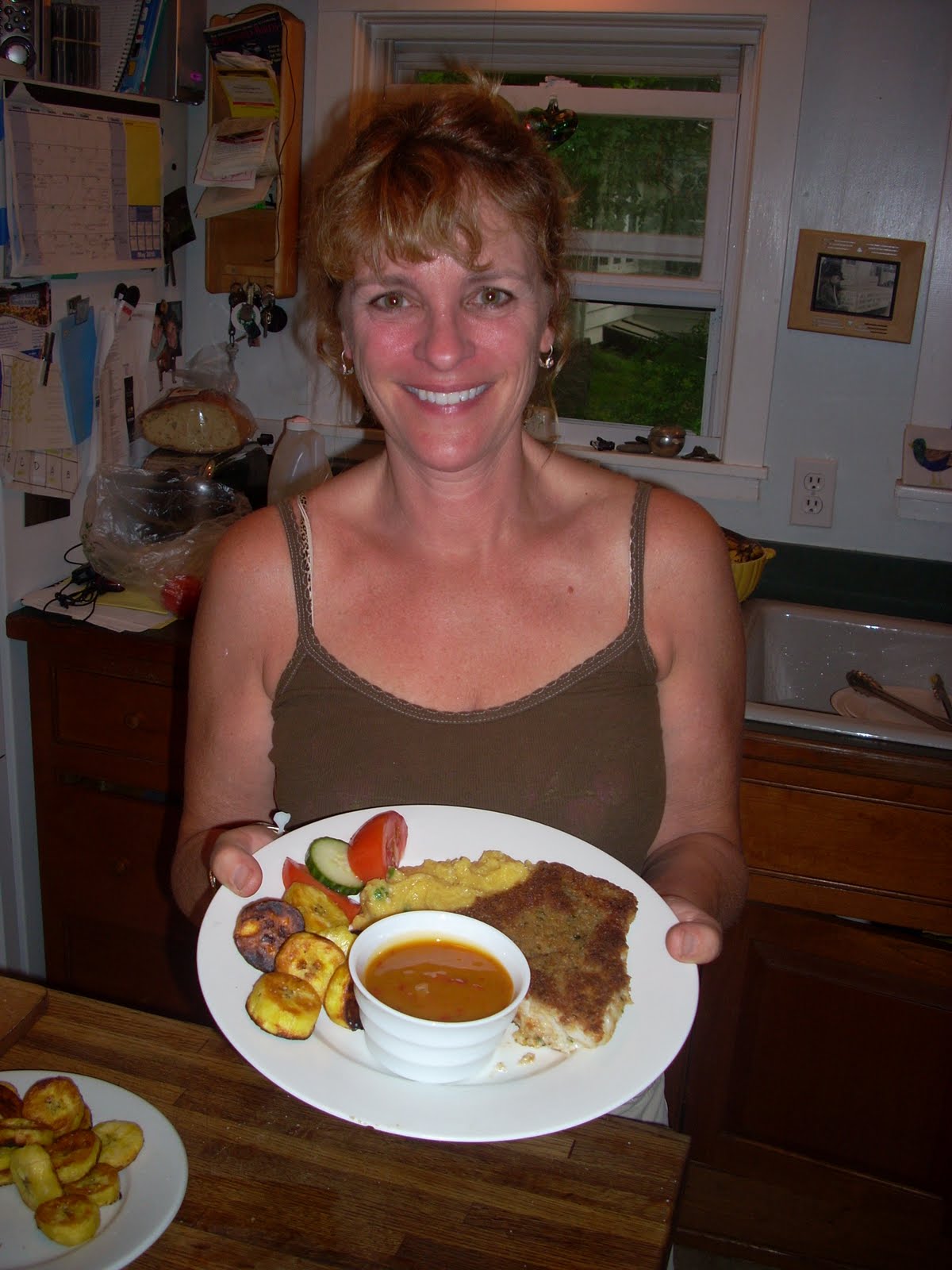
Following is the meal I prepared:
Cou Cou (kind of a cross between Polenta and Grits, cooked with Okra)
Fried Grouper Fish (absolutely delicious, but not cheap)
Plantains (yellow, not green) with a Mango Sauce
Sliced tomatoes and cucumbers
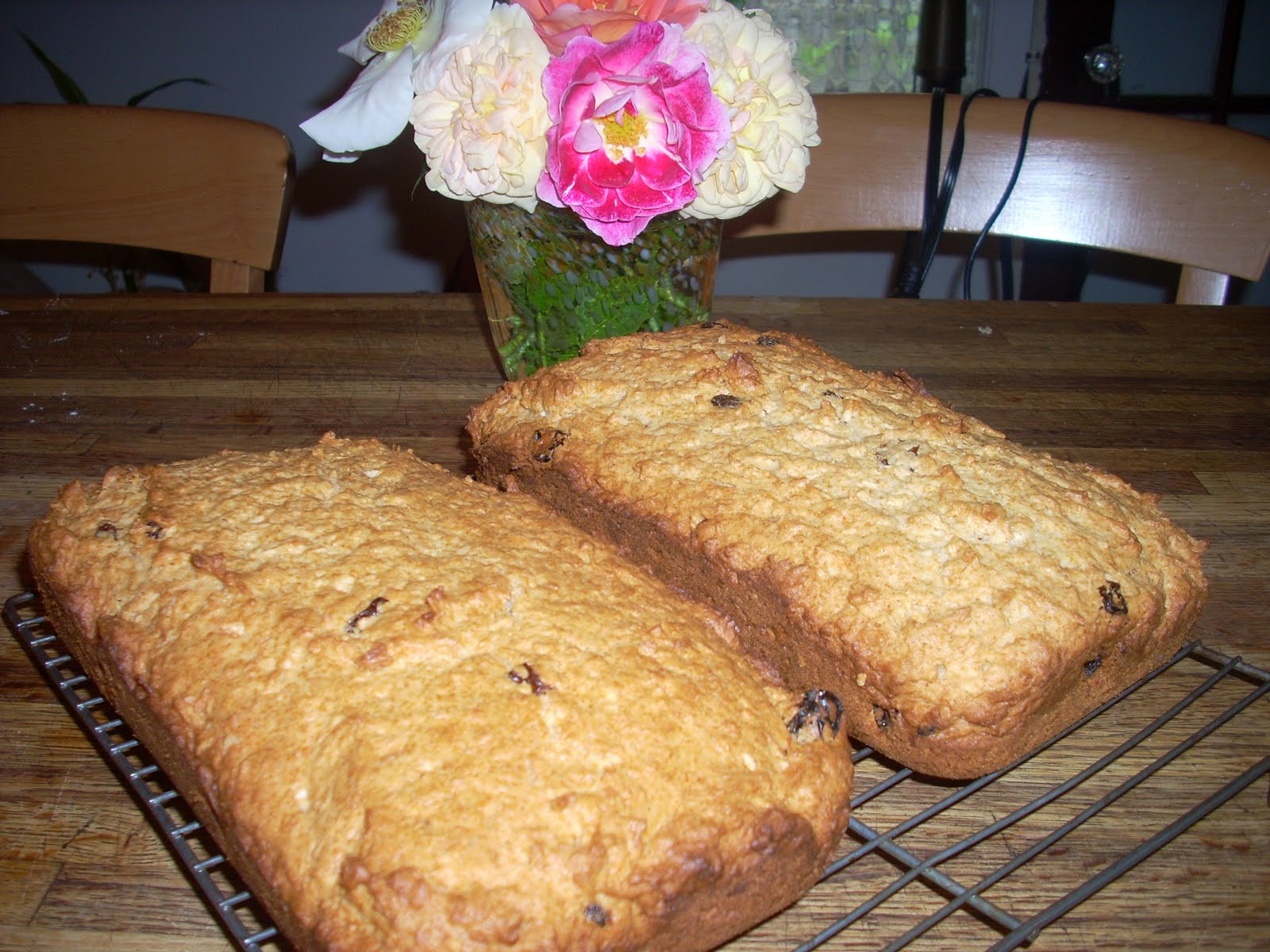
Coconut Bread
Ingredients
Cou Cou
Flour, Egg, Bread Crumb Coating for the Grouper
Fryin' up the Grouper in a heavy copper pan & Cou Cou
Beautiful Golden Plantains
Coconut Bread
Tadahhhhhhhhhhhhhhhhhhhh
Recipes
Cou Cou
6-8 okras sliced
6 cups water
2 cups corn meal
salt and black pepper to taste
1 tbsp butter
Boil 4 cups water in a medium-size pot then add the thinly slice okra.. Cook for 10 to 12 minutes or until soft and lower the heat.
While the okra is cooking, mix the corn meal with 2 cups of cold water in a bowl.
Add the corn meal mixture to the pot with okra. Add salt and pepper to taste. Mix well and cook on low, stirring constantly with a wooden spoon.
The cou-cou is done when it's stiff and separates away from the sides of the pot.
Serve on a dish with butter on top with flying fish (or Grouper)
Fried Grouper (Flying Fish)
1 lb fillet flying fish
2 eggs beaten
Lime or lemon juice
1 tsp thyme
1 tbsp onion powder
1 tbsp garlic powder
bread crumbs
flour
Salt, black pepper, and hot pepper to taste
Clean fish with lemon or lime juice then rinse with water.
Season the fish with thyme, onion and garlic powder, salt, black and hot pepper. Set aside for at least an hour in the fridge.
Coat the fish in flour then dip in beaten egg and coat with bread crumbs.
Fry in hot oil for about 3-5 minutes on each side then drain on a paper towel.
Serve with cou cou.
Plantains
2 yellow plantains
oil for frying
Slice plantain in 1/2 thick slices
Fry in oil till golden brown
Drain on paper towels
Serve with Mango sauce
Coconut Bread
6 ounces brown suga
6 ounces shortening
1 large egg, beaten
3 cups grated coconut
1 teaspoon powdered cinnamon
1 teaspoon powdered nutmeg
2 teaspoons almond extract
¼ pound raisins or mixed fruit
1 cup milk
1¼ pounds flour, sifted
½ teaspoon salt
1 Tablespoon baking powder
Directions
Preheat oven to 350° F .
Combine shortening and sugar.
Add the beaten egg, and mix thoroughly.
Mix in the spices, almond extract, fruit or raisins, grated coconut, and milk.
Add flour, salt, and baking powder and mix thoroughly.
Pour the batter into two greased loaf pans—a one-pound pan and a two-pound pan.
Bake loaves for one hour, or until browned. Cool on racks before serving.
Final Assessment: We loved the entire meal - especially the Grouper and Cou Cou combination!
Cooking in Bangladesh tonight was especially fun, because the recipe did not come from the internet. Instead, I was given the recipe by my friend and colleague, Sangeeta Dey - a brilliant Pediatric Neuropsychologist I first met while working on a very complex case, but who has since become a wonderful friend. Sangeeta's father, Gopal Deas, is Bengali, so she was kind enough to pass on a traditional meal that is regularly eaten in households through out Bangladesh.
Because Bangladesh has such a rich and complex political and religious history, I didn't feel I could do the country justice by condensing it's historical time line into a few sentences, so I've included a link which I think gives a fairly good overview for those who are interested: http://www.discoverybangladesh.com/history.html and a band to check out as well: http://www.youtube.com/watch?v=4VMtZ8B4tCU
The dish is called Mangsho'r Jhol - translated, Beef Curry. Now, I know what you're thinking...aren't cows sacred in India? Yes they are, but Sangeeta tells me that 80% of the population in Bangladesh is Muslim, the remaining 20% are Hindu who do not eat beef for religious and spiritual reasons.
Here are some of the wonderful ingredients I used to prepare this meal: potatoes, ginger, onions, garlic, cinnamon stick, bay leaves and cloves
Turmeric, Coriander and Cumin
It was well over 90 degrees today, and my kitchen must have been at least 100. As I was seriously sweating over the stove - okay, and I had really big hair too, I imagined this is what a kitchen in Bangladesh during the summer would be like, so I suppose the sweltering temperature lent authenticity to preparing this meal. And, once again the smell of the rich spices filled up the house with such an exotic aroma, that in combination with the heat, I felt I could have been in Bangladesh, preparing an evening meal for my family. Bridging cultural divides, crossing oceans to distant continents without leaving my kitchen - what an adventure on so many levels.
We ate the meal outside, because it really was too hot in the house. My family LOVED the dish - it had just the right amount of heat and spice, but was offset by the tomatoes and yogurt. Final assessment - we'll mos' def' be having this again.
Gopal Deas's Mangsho'r Jhol - Beef Curry
1 lb. beef (any cut) cubed
2 bay leaves
1 cinnamon stick
a few cloves
1 medium finely chopped onion
Sautee onions in oil, add beef, bay leaves, cinnamon stick and cloves in a heavy pot. Cover with lid and simmer, adding a little water at a time for form a gravy.
When beef is cooked about half way, add more water to make gravy then add:
Winter is the easiest time of year to feel motivated to cook. When it's cold outside nothing is better than hunkering down in a cozy kitchen to braise and bake and simmer the day away. Summer time is perhaps the toughest season for cooking. Who wants to be in the kitchen when the weather is beckoning you to stay in the sun? When I think of Summer I think of tomato salads, guacamole, ceviche and big antipasto platters served al fresco. And of course anything and everything on the grill.
There are tons of grilling cookbooks and each season a new batch comes out (in fact you can find a recent round up of grilling book reviews on MattBites). But this year there are two Summer cookbooks that go way beyond just grilling, giving you many more options when things heat up. They are very different books, though either would be perfect to take with you on Summer vacation to a beach house or mountain cabin, or make a great hostess gift.
The Big Summer Cookbook is a soft cover book with 300 recipes written by author Jeff Cox who seems particularly attuned to what is ripe and in season. The book starts with a Summer seasonality chart and perhaps even more interestingly a section on how to stock your Summer pantry. This would be helpful in planning meals for a week at a Summer house. There are recipes for no-cook dishes such as Mango Watermelon Salad and Caprese Skewers as well as some baked goods that you will want to eat during the Summer such as Plum and Nectarine Crisp and Sour Cream Breakfast Cake. Recipes I have bookmarked include a No-Cook Blackberry Pie that features a graham cracker crust and a Couscous Salad with Pine Nuts and Summer Fruit. The vegetable and fruit recipes are more interesting in general than the meat recipes which tend to be standbys such as burgers and grilled chicken. There are some new ideas in this book, but it's really more about the basics. Read an excerpt.
By contrast, the substantial hardcover Recipes from an Italian Summer will make you dream of Summer in a villa eating dishes like Grilled Sardines scented with Orange, Wild Duck with Figs, and Spaghetti and Lobster. It begins with a seasonal food calendar and features nearly 400 exciting and adventurous recipes. These are primarily Italian recipes, many you have not likely seen before. With a few notable exceptions, they are generally not complicated dishes and in tune with the season but written for someone who is a confident cook. By "in tune" I mean things you might want to eat in Summer, as there are recipes using ingredients not strictly available in the Summer like apples and radicchio. Here and there the recipes suffer from less than optimal translations. But they are the things you will want to eat when you get bored of tomato salad and grilled chicken. The book has gorgeous photos of food in a rustic style and lots of photos of Italy. If you love Italian food you will find this book deeply satisfying because of the many fresh ideas it presents although there is some overlap with the Silver Spoon cookbook. Personally I can't wait to make dishes like Potato Pizza and Sunflower Petal Salad. It's a book that inspires. Look inside the book.





 By contrast, the substantial hardcover