-->

Sunday, June 27, 2010

Day 24 - Brazil! Feijoada and Pão de queijo - Up Next, Brunei (vegetarian)

Feijoada  and  Pão de Queijo

Our family is blessed to have some very close, special Brazilian friends and family in our lives who frequently treat us to wonderful home cooked, traditional meals. And, while the meal  I prepared tonight couldn't begin to touch the quality of their cooking, I do hope that the love and respect we feel for them and their beautiful country is conveyed in spades. We love you, Ben, Juciene,Juliane, Danielle, Anna Julia and of course, my other son, Jon.

I love technology. This is  how we arrived at this meal: Ian got on his Blackberry to survey his friends. Tim got on his iPhone to check with his friends, I went to the web and texted our friend Ben...After receiving input from numerous friends and sources, I was advised to try my hand at none other than the National Dish of Brazil, the hearty Feijoada stew and Pão de queijo, cheese rolls

This recipe takes some time to cook, (about 30 minutes to prep and 3 hours to cook), and since I didn't know what the Hell I was doing, I started at around 3 p.m. to ensure that we'd be having dinner before midnight. No pressure, though! 

Oh, look! John Hiatt just happened to stop in to see what I was cooking...You know, he's on tour right now and doesn't often get a good meal - what a lovely surprise...can you sing "My Old Friend" while I chop these onions? Thanks, you're a doll.
A little aside about this meal: a few readers have suggested I include more vegetarian dishes, which I think is a great idea . I truly appreciate the constructive criticism and feedback because one never knows who, if anyone, is actually reading the stuff I ruminate about! HOWEVER....Brazil is not the country to try to go vegetarian in ... Brunei is up next, and I intend to suppress my meatatrian tendencies as promised!

Brazil is the largest country in South America and borders every other South American country except Chile and Ecuador. From west to east it stretches nearly 2,700 miles from the Andean foothills eastward to the Atlantic Ocean. Its official name is the Federal Republic of Brazil, or, in Portuguese, the Republica Federativa do Brasil. It occupies almost half the area of South America and is the world's fifth largest country. Although just slightly smaller than the United States in area, Brazil's population is about 40% less. 
 
The  national cooking style marked by profound differences. Depending on the section of the country, the food varies hugely in ingredients and influences. For example, in Sao Paulo, the influence of European and North African immigrants is noticed in the region's cuisine. The majority arrived from Italy, along with many from Portugal and Spain, plus other Europeans and Arab countries. In the north, (Acre, Amazonas, Amapá, Pará, Rondonia, Roraima, and Tocantins) the region is known as Amazonia as it includes a large part of the rain forest, and tributaries flowing into the Amazon River. Culturally, the Amazon basin is heavily populated by native Indians or people of mixed Indian and Portuguese ancestry who enjoy a diet of fish, root vegetables such as manioc, yams, and peanuts, plus palm or tropical fruits.
 Some ingredients I've never cooked with before: Almidon de Yuca (tapioca starch), queso blanco fresco (white farmer's cheese)
Roasted smoked pork sausages, linguica, pork and slab bacon - serious amounts of meat!

 
Seasoning: scallions, garlic, onions and spices


The stew simmering away

Making the cheese rolls -yay!


Pão de queijo


The final product!!

Ingredients:

  • 2 cups (1 pound) black beans, rinsed and picked over
  • 3/4 pound pork butt or shoulder, trimmed of fat
  • 6 ounces slab bacon
  • 1/2 pound smoked pork sausages
  • 1/2 pound hot Portuguese sausage such as linguica
  • 1 or 2 pounds ham hock or shank, cut into 1-inch rounds
  • 1 large yellow onion, chopped
  • 2 to 4 ounces dried beef carne seca, minced (optional; see Note)
  • .
  • For the Seasonings:
  • 3 garlic cloves, minced and sauteed in 1 tablespoon vegetable oil
  • 6 green onions, including tops, chopped
  • 1 yellow onion, chopped
  • Large handful of chopped fresh parsley (about 1/2 cup)
  • 2 bay leaves, crumbled
  • 1-1/2 tablespoons dried oregano, crushed
  • Salt and ground black pepper
  • Chopped fresh cilantro or parsley

Preparation:

Soak the black beans overnight in water to cover by several inches. Drain.

Place the drained black beans in a saucepan and add water to cover by 3 inches. Bring to a boil, reduce the heat to low, cover, and simmer until the beans are tender, 2 to 2-1/2 hours. Add additional water as needed to keep the beans covered.

While the black beans are cooking, prepare the meats. Preheat an oven to 375 degrees F. Dice the porl butt kor shoulder and the bacon into 1/2-inch cubes. Place the pork, whole sausages, and bacon in a large baking pan. Roast until well done. The sausages will be ready after 35 to 40 minutes and the other meats after 45 to 60 minutes.

Cook the ham hock at the same time as the meats are roasting. In a saucepan, combine the ham hock rounds and onion with water to cover. Bring to a boil, reduce the heat to a simmer, and cook until tender, about 1 hour. Remove the ham hock rounds from the water and remove the meat from the bones, if desired; set aside. Or leave the rounds intact for serving alongside the black beans. Strain the cooking liquid into a bowl. Add the strained onions from the liquid to the beans. Add the cooking liquid to the beans if needed to keep them immersed.

Once the black beans are almost cooked, check to make sure there is plenty of cooking liquid in the pot. It should be rather soupy at this point. Stir in the beef carne seca. Cut the sausages into rounds and add them and all the other cooked meats to the pot. Then add all of the seasonings to the pot, including salt and pepper to taste. Simmer for another 30 minutes, or until the beans are very tender.

Taste and adjust the seasonings. Sprinkle with chopped cilantro or parsley just before serving.

NOTE: Using dried beef adds complexity to the richness of this dish, but its inclusion is optional. If dried beef isn't available at your butcher, Armour makes a ground compressed dried beef sold in 2-1/2-ounce jars. Soak it in warm water to cover for 15 minutes to rinse off some of the salt.

Yield: 8 servings

Brazil is famous for its pão de queijo - cheese rolls with soft chewy centers. Pão de queijo is made with cassava flour (tapioca flour), the ground root of the manioc plant. They smell wonderful when they are baking, and plump up into perfect round balls. Many recipes call for parmesan, but if you can find the Brazilian cheese queijo minas in your local Brazilian market, your pão de queijo will be even more authentic. Regular farmer's cheese or any other firm, fresh cows milk cheese work well in this recipe.

 Pão de Queijo- http://southamericanfood.about.com/od/breads/r/paodequeijo.htm

Prep Time: 15 minutes

Cook Time: 25 minutes

Total Time: 40 minutes

Ingredients:

  • 2 cups whole milk
  • 8 tablespoons butter, melted
  • 1/2 cup vegetable oil
  • 4 1/4 cups tapioca flour
  • 4 eggs
  • 2 cups grated farmer's cheese, or any firm, fresh cows milk cheese
  • 1/4 cup grated cheddar cheese (optional)
  • salt to taste

Preparation:

  1. Preheat the oven to 350 degrees.
  2. Mix milk, salt, vegetable oil and butter in a pot, and bring to a boil. As soon as it boils, remove from heat.
  3. Stir tapioca flour into the milk and butter mixture.
  4. Stir in the eggs and the cheese, and mix well.
  5. Let mixture cool for 15-30 minutes, so that it will be easier to handle. (I like to chill it in the refrigerator for 15 minutes or so).
  6. With floured (tapioca flour) hands, shape the dough into golf ball size balls (about 50 gram portions) and place them on a baking sheet.
  7. Bake rolls for 20 to 25 minutes, until they are puffed up and are golden. They will rise slowly and puff up mostly in the last 5 or 10 minutes.
  8. Serve warm.
Makes about 15 rolls

Final Assessment:  This is very good, but very heavy food. The flavors are rich, and anything with black beans works for me. But we all agreed that a little goes a long way. The cheese rolls were great - also heavy, but totally addicting! Go for it if you have the time and want a delicious hearty meal!

Wednesday, June 23, 2010

Day 23-Botswana - Chicken and Groundnut Stew - Up Next Brazil

 Bostwana Chicken and Groundnut Stew
First time trying my cast iron pot on the fire pit!!
 Buddy keeping an eye on things in the background...just in case....

Many years ago, my brother Clay (I love you, Yo) gave me a beautiful cast iron pot. The thing weighs about 7lbs and when full, takes two hands to lift. Until tonight, I haven't used it much, in fact, at one time, it held our spare change. But when I started researching how food was cooked in Botswana, I learned that stews are a national staple, and that they are often cooked in a "three legged" pot on a hot bed of coals! Yay! My sister, Anna (I love you, Gamma) suggested I include a poem she read that appears in the No. 1 Ladies Detective Agency series, which takes place in Botswana, but I couldn't find it anywhere!

After consulting with my friend John, a.k.a Sparky, I set up the cooking surface by putting several flat stones right on the grill to ensure that the bottom of the pot wouldn't burn. John suggested bricks, but I didn't have any, so I used what I had - a few flat(ish) rocks I found in the yard.

I knew I had to build a really good fire because it had to be hot enough to heat the heavy pot to simmer the  stew for an hour before cooling down. I chopped up some good fire wood and collected kindling from around the yard to build a good base for the charcoal. I was advised to wear steal toe boots while chopping wood, but, well ...I admit it, I'm a chick and have chopped wood, in high heels for God sake.
The wood shed: I used a maul, 2lb. sledge hammer and hatchet to chop up nice pieces of well seasoned wood
This afternoon I built up the fire pit by adding a few more stones. I also planted  a Yarrow  my friend Sangeeta gave me and Tim's Bamboo for the heck of it.
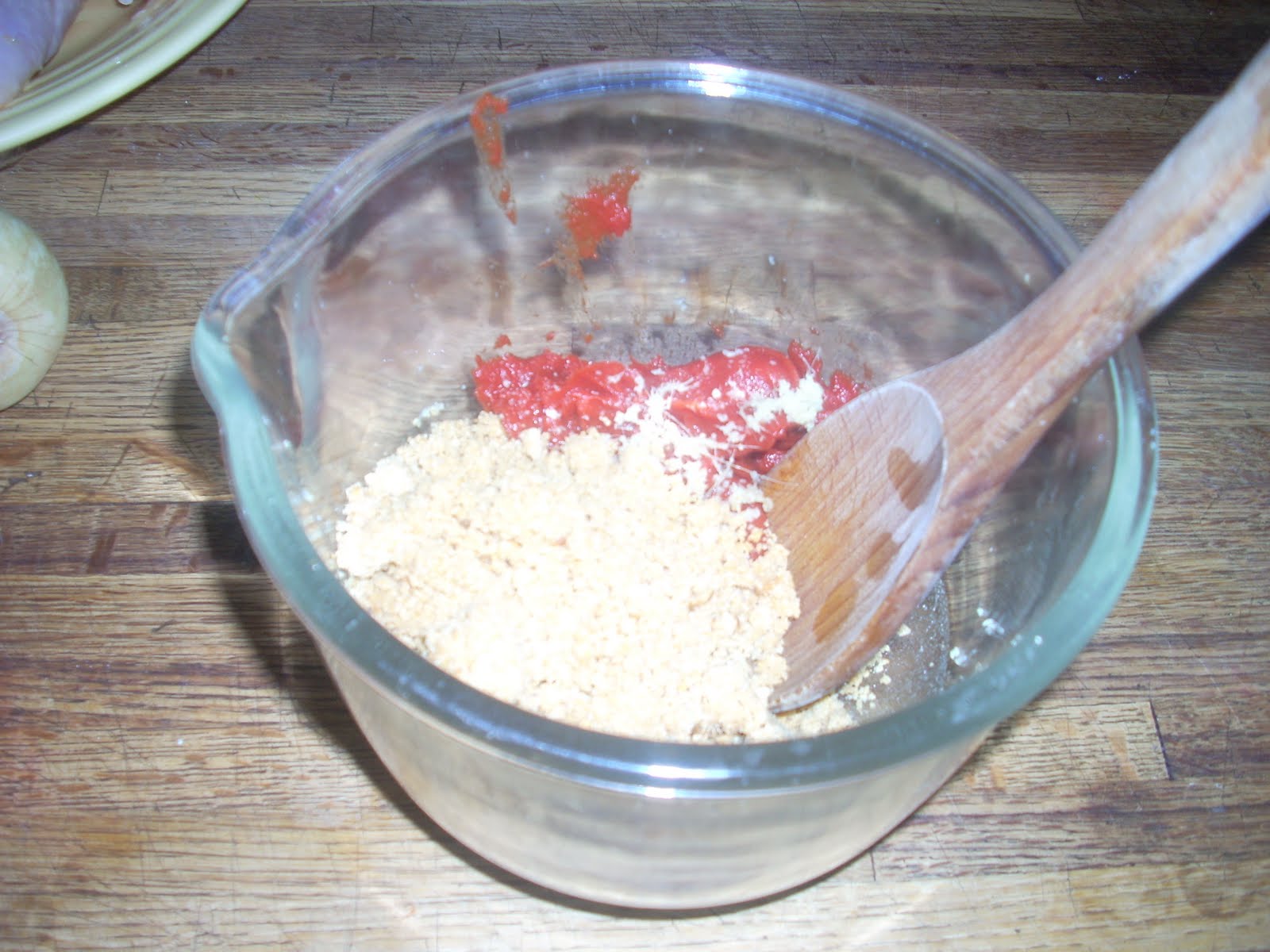
 The Ingredients: brown sugar, ground peanuts (I ground them in a coffee grinder), cayenne, ginger, onion, tomato paste and chicken - I asked the butcher at my local grocery store to cut up a Perdue Oven Roaster (www.perdue.com/) because I'm tired of buying scrawny, fatty chickens and it was great!!

 The Peanut sauce: ground peanuts, tomato paste, grated ginger, brown sugar,  cayenne and water - well awright
I cooked the onions until they were translucent, added peppers and browned the chicken

 When the chicken was browned, I poured on the sauce and put the lid on to let the stew simmer away for about an hour

Unbelievable - It actually works!!


Now, about Botswana...
Twice the size of Arizona, Botswana is in south-central Africa, bounded by Namibia, Zambia, Zimbabwe, and South Africa. Most of the country is near-desert, with the Kalahari occupying the western part of the country. The earliest inhabitants of the region were the San, who were followed by the Tswana. About half the country today is ethnic Tswana. The term for the country's people, Batswana, refers to national rather than ethnic origin.
Botswana

Sorghum or corn meal porridge is the staple of most Botswana meals. People wake in the morning to a thinner version of the porridge, sometimes enriched with soured milk and/or sugar, and tea. A thicker version of the porridge, known as bogobe , anchors the substantial midday meal, accompanied by a stew of meat and/or cabbage, spinach (or wild greens), or beans. People also use rice, but it is considered more expensive and associated with Europeans. Meats include chicken, goat, sheep, cattle, fish, a caterpillar known as phane and various wild game. Village evening meals may include leftovers from midday, but for many people is often just tea and buttered bread.

The interior of a hut along the Okavango Delta. Fifty percent of Tswana households are headed by women.
Final Touches

I picked lettuce and herbs from my garden for the salad

Voila: Chicken Groundnut Stew, Rice and Green Salad, eaten outside because it's too hot in the  house and there's something about eating outside that makes everything taste better.

The Recipe
Botswana Chicken Groundnut Stew
  •  Chicken, cut up 
  • 1 Tbsp vegetable oil 1 med onion, chopped
  • 1 green pepper, chopped
  • 1 Cup water
  • 1/2 Cup peanut butter
  • 1 4oz can tomato paste
  • 1 tsp grated fresh ginger root
  • 2 Tbsp brown sugar
  • 1/8 tsp ground red pepper 
First, prepare the peanut sauce: in a bowl, combine the sugar, red pepper, ginger, peanut butter, and tomato paste. Slowly stir in the water, a small amount at a time, until the sauce is smooth. Set aside.
Heat the oil in a large pot over medium heat. Add the chopped onion, cooking 5-7 minutes until onion is translucent. Add cut-up chicken and green pepper. Cook until the chicken and the onion are brown and the green pepper is soft. Pour the peanut sauce over the browned chicken, peppers and onions and stir well. Cover the pot and and reduce heat to low. Simmer, covered, for 1 hour, stirring occasionally.
To serve, spoon servings of Groundnut Stew over Rice Balls, or on a bed of white rice.
Rice Balls
  • 1 Cup short grain rice
  • 3 1/2 Cups water 
  • 1 tsp salt
Cook rice according to directions on package. When rice is cooked, use a potato masher or fork to mash the rice until it begins to clump together. Wet your hands with cold water, and taking a clump of rice in your hands, form it into a ball. Place rice balls on a serving platter or individual plates.
Traditionally served with soup or stew, which is spooned over the rice.

 My in-house food critics, Tim and his best friend, Mac - diggin' the stew!


Final Assessment: I loved this meal and I loved cooking it on the fire. The flavors were rich and had that taste that only food cooked on wood and charcoal takes on. I'd make this again any day. Of all the meals I've prepared, those from Africa and the Caribbean countries have been my favorites.


Aloha!

Tomorrow I will be heading to one of my favorite places in the world for a birthday celebration/vacation, Hawaii. It also just happens to be one of my favorite dining destinations. In addition to eating, swimming, exploring and shopping at my favorite island farmer's market, on this trip I am looking forward to attending an Obon festival and finally meeting my favorite Hawaiian food blogger.

Hawaii

Since this is my vacation, I will not be blogging from the beach. If you have any hot tips or favorite restaurants on Oahu, please feel free to leave a comment. In the meantime you can check out my Honolulu Dining Guide below.


I will surely be adding to it when I return...

Until next week,

Aloha!

Amy

Tuesday, June 22, 2010

Archway Cookies: A Nostalgic Review

When I was growing up we didn't have soda or candy in the house, or junk food like Twinkies, but we did have cookies. Sometimes my mom made cookies from scratch, and sometimes she bought them. The thing is, some cookies need to be fresh and homemade, like chocolate chip cookies or oatmeal cookies. They just don't taste right to me if they aren't. But then there are some commercially produced cookies that are just fine and dandy.

When I was growing up I can almost guarantee you would have found pecan sandies, lemon coolers, raisin biscuits, or almond windmills in the cookie jar. Oddly enough most of those cookies are not so easy to find these days. Pecan sandies are a kind of shortbread cookie, flecked with bits of nuts and are the only cookie I still routinely see in the supermarket (though reviews seem to say they aren't as good as they used to be). Lemon coolers were very tangy cookies coated in powdered sugar. Raisin biscuits were affectionately known as "fly biscuits" in my family. They were thin layers of cookie, filled with raisins. They came in long strips that were perforated. Almond windmills later became just "windmills", as the amount of slivered almonds was drastically reduced. Windmills are based on a spiced Dutch cookie called speculaas.

Recently I got an email informing me that Archway was launching an iced lemonade cookie. Was I interested in trying some samples? Little did I know I would receive 13 packages of cookies in the mail. 13. Packages. Of cookies. So for you, my dear readers, I opened virtually every package and tried them. Call it professional responsibility. Somebody has got to try all those cookies and it might as well be me! Not every cookie made the cut, but a few varieties rose above the rest. Here are the ones I think are particularly noteworthy:

molasses cookies
Molasses Cookies
These are soft big cookies with a lingering molasses flavor and a bit of crunch from the decorative sugar crystals. Perfect with a mug of black tea and milk.

ginger snaps
Ginger Snaps
I like these a lot. They really have a good bite of ginger in them and are not too sweet. They would also be great in desserts. I'd use ginger snap crumbs in place of graham crackers to make a press in type of crust or to top an apple or pear crisp.

iced molasses
Iced Molasses
You have to like molasses to appreciate these chewy little gems, but I enjoyed them even more than the larger soft molasses version.They are really good and strong like a bracing cup of black coffee.

iced lemonade
Iced LemonadeThese are not my beloved lemon coolers, but I like them. They are tangy, not too sweet even though they are frosted. Actually I think most of the lemon flavor comes from the glaze. They are small and very crunchy.

windmill cookies
Windmills
These are practically as I remember them, just light on almonds. From the photo it's impossible to see any almond flakes, but they are in there. The primary flavor is cinnamon but there are other sweet spices too. Windmills are hard cookies, but not as hard as the ginger snaps. They have an almost melting sandy texture. Are they that delicious or am I just being nostalgic? Hard to say. But I am enjoying them immensely.

You will find these cookies in various supermarkets.

What store bought cookies do you love or miss?

Monday, June 21, 2010

Day 22 - Bosnia and Herzegovina! Čevapčići - Up Next, Botswana

Ćevapi (Čevapčići): rolled spiced meat patties, shaped somewhat like a cigar and served with somun (thin pita-bread), onions, and yogurt. Considered to be the national meal of Bosnia.
 Way too hot to cook inside...good thing I just happen to have this handy cooking pit!

I've been thinking about how women all over the world are charged with feeding their families in times of extreme economic hardship, war, drought, floods, disease and any number of natural and man made catastrophes, the likes of which I have never  known. Through this project, I feel a growing, deep respect and appreciation for what it must take to put food on the table in countries such as Bosnia and Herzegovina given it's very recent history of war and genocide. 

Although I've never known the ravages of war or disaster, I grew up watching my single Mom make meals for my bother, sister and me with very, very little. Although there were times when peanut butter and jelly was dinner and seconds on meat just wasn't going to happen, she somehow managed to bring us all together at the table every night with a home cooked meal that fed both our bellies and our souls. So while I don't pretend to know what women and their families in these foreign lands experience in reality, I do imagine that a mother's drive to care for and feed her children is fierce and universal and knows no ethnic or religious boundaries.
Bosnia and Herzegovina (Sarajevo)(EU): It's hard to know how to write about this country because it's history, both ancient and present, is so complex. Anything simplified risks sounding, well, simplistic. Conversely, the amount of time it would take to accurately capture both the beauty and the devastation this country has withstood would disinterest all but the most avid historian....

So here's just a little history and a link for those who wish to know more: Bosnia and Herzegovina make up a triangular-shaped republic, about half the size of Kentucky, on the Balkan peninsula. The Bosnian region in the north is mountainous and covered with thick forests. The Herzegovina region in the south is largely rugged, flat farmland. It has a narrow coastline without natural harbors stretching 13 mi (20 km) along the Adriatic Sea.

The three main ethnic groups in present-day Bosnia and Herzegovina are Bosniaks, Serbs, and Croats, and languages are Bosnian, Serbian, and Croatian (formerly "Serbo-Croatian"). Nationalities are Bosniak (Bosnian Muslim), Bosnian Serb, and Bosnian Croat. Religions include Islam, Serbian Orthodoxy, Roman Catholicism, Judaism, some Protestant sects, and some others. Here's a link that covers Bosnia and Herzegovina's history up to present day quite thoroughly: http://www.infoplease.com/ipa/A0107349.html

The Meal
I decided to make Ćevapi (Čevapčići), a traditional meat patty, shaped somewhat like a cigar, grilled and served with a wonderful cucumber-yogurt sauce in pita bread.  The recipe I used called for pork, but I came across conflicting information about whether or not pork is eaten in this predominantly Muslim country, so I decided to err on the side of caution and omit the pork altogether. I just doubled up on the lamb instead.

Ground lamb, veal, grated onions, garlic and lots of Hungarian paprika are combined (as you would meatloaf)


Roll and shape meat into cigar shapes - then put in fridge for about an hour to firm up....


 Grate cucumber- I used an English cucumber because it doesn't have to be peeled so lends a beautiful green color to the otherwise white yogurt sauce


Set grated cucumber over sieve to drain for one hour

Combine plain yogurt, fresh lemon juice, garlic, caynne and cucumbers to make sauce
 

Grill meat over nice hot fire - I used a combination of wood and charcoal-no lighter fluid!

Grill pita bread for a few seconds on each side

Two thumbs up from Tim and his best friend, Mac. who has decided to join us as we cook our way around the world this summer - I just love that boy!

  • 1 lb ground lamb
  • 1 lb ground veal
  • 1 lb ground pork
  • 1 large yellow onion, peeled and grated
  • 3 cloves garlic, peeled and crushed
  • 3 tbsp hot Hungarian paprika, or sweet paprika and a little cayenne
  • 2 tbsp freshly ground black pepper
  • salt to taste
  • Pinch of freshly grated nutmet
  • olive oil for basting

 Yogurt sauce

  • 1 pint yogurt
  • 1 cucumber, peeled, grated and drained 1 hour
  • 2 cloves garlic, peeled and crushed
  • Juice of ½ lemon
  • salt and ground pepper to taste
  • Pinch of cayenne pepper

Directions

  1. Mix all the ingredients, except the oil, thoroughly and roll the mixture into little "cigars" about 1 inch by 3 inches.
  2. Rub lightly with olive oil and grill or broil until done.

 Yogurt sauce

  1. Mix together all the ingredients and serve with Pita bread
Final Assessment: Delicious, easy to make and fun to eat. The cucumber yogurt sauce was cool and clean tasting and complimented the grilled meat beautifully.


Wednesday, June 16, 2010

Day 20 - Bhutan! Pork Fing & Cucumber Salad - Up Next, Bolivia


 Walden Street, Cambridge, MA
(L-R) My brother Clay, Me and my sister Anna
a.k.a. The Mod Squad 

It's 1970 and I'm in my hometown 5th grade classroom at the Peabody School in Cambridge, MA.  Today is Friday, Geography quiz day and my sweltering classroom smells faintly of paste, sour milk cartons and 10 year old bodies, almost, but not quite ready for deodorant.

A large, stern man with a booming voice, pale blue eyes and perpetual 5 o'clock shadow, my teacher, Mr. Coleary, delights as he summons each student up to the front of the room to recite America's 52 states aloud  from memory. When he finally calls my name I'm dizzy with fear. I make my way up through the long rows of tan metal desks and snickering kids and I know I'm in big, big trouble, because try as I might, my brain does not memorize well. I take my place in front of the class, my sweaty hands are jammed deep into the pockets of my orange and blue plaid jumper. My heart is pounding so loudly it drowns out every sound around me.  With sadistic power and a wink,  he cues me to begin, but I'm rendered completely unable to rotely spit back even a third of the states I've studied. I fail miserably and continue to do so with impressive consistency all year long. I don't learn a thing in Mr. Coleary's 5th grade class except fear...and maybe a little toughness, which it turns out, serves me well later on.

Fast forward 4 decades to 2010. I'm in my happy kitchen. What's Cooking in your World  is my shot at a Geography and History do-over. An extraordinary opportunity to fearlessly and passionately learn and re-learn about our small/big world in a meaningful, contextual way and to share this rich experience with my kids. That's what I'm talkin' about.


Bhutan is roughly the size of Switzerland 

Bhutan (Thimphu)(AS): Traditionally called "Druk Yul,"  Bhutan is a land-locked country with no access to the sea. Located in the eastern Himalayas, it's bordered by India in the south, east and west, and by the Tibetan Autonomous Region of China in the north.
The origin of Bhutan and its earlier history is  unknown. Guru Padma Sambhava, an Indian saint made his legendary trip from Tibet to Bhutan at the end of eighth century. Many say Bhutan's history and cultural is mystical.

Chilies of many varieties are the primary spice used in Bhutanese cooking 

The Bhutanese are passionate about chili. The species of chili used here is Capsicum onum, a fluffy red variety. Chillies are spread all over – on the roadsides, on rooftops and on the courtyards. Huge baskets of chilies at the market put to shame the bursting pumpkins, white radish, potato, cabbage, cauliflower and beans.


Though they appreciate the pleasure of meat, being a Buddhist country, slaughter of animals is restricted. In Bumthang, a district in eastern Bhutan, slaughter of animals is not allowed at all. But you can eat the meat if the same animal fell off a cliff. These days, some of the traditional ways of preparing food haveb een replaced by more convenient Western foods, however for special occasions and celebrations, traditional meals continue to be enjoyed. Regardless, Bhutanese food is HOT.


The Menu
Cellophane noodles, Thai green chilies, seedless cucumbers and pork

Cook on low heat until meat is tender 
Soak cellophane noodles in boiled (not boiling) water for 20 minutes

 Pulse cucumbers, red onions and chilies in food processor or chop by hand
Top with Farmer's cheese which tempers the heat of the Pork Fing dish nicely
Oh wait - the Jello is for my boys who pierced their tongues this week and can't eat this delicious meal
*Note I used ice for the "quick set" method  - Jello for dummies for real


Plated, delicious and plenty, plenty HOT
Final Assessment: We loved this dish. The chilies were very, very hot - even though I used less than the recipe called for, knowing that I'm a chili pepper nube and couldn't handle that much fire without building up to it first. The salad was beautiful and cool and had just the right amount zing from the red onions-topped with the Farmer's cheese, it was perfect.
Music Sweet Music


Free Healthy Recipes!

ThinkFood
How would you like to receive 50 free "brain healthy" recipes? Food bloggers from around the world contributed to a special recipe collection called ThinkFood, put together by Posit Science, a leader in brain training interactive software programs, designed to help users think faster, focus better and remember more. Posit Science takes an integrated approach to brain health that includes brain training and now brain healthy eating.

Visit the website to sign up for a recipe of the week. After signing up you'll be able to see the recipe online as well. This week the recipe is for Banana Oatmeal Chocolate Chip Cookies and includes brain healthy ingredients such as chocolate, banana, flax, and walnuts. It's from food blogger Tina Haupert of Carrots 'n Cake and it looks great! On the web site you'll get the recipe, cooking tips, meet the food blogger and learn about brain healthy ingredients.

You will also be able to purchase a copy of the hard cover book when it is available in July. I'll let you know when my recipe is available in August.

Here is the complete list of sites that contributed recipes:

Ambitious DeliciousnessAnne’s FoodApples and ButterThe Arugula FilesBest Fruit NowBrown Eyed BakerCarrots ‘N’ CakeChocolate ShavingsCloset CookingCooking with AmyDaily Unadventures in CookingDash and BellaDine & DishDixie CaviarEclectic RecipeseCurryFake Food FreeFood BloggaFood Loves WritingFor the Love of CookingGourmet FuryGreedy GourmetHangry PantsHealthy EverythingtarianHerbivoraciousKatiecakesLa Note RestaurantLaurel On Health FoodThe Leftover QueenLisa’s KitchenLocal AppetiteThe Lunchbox BunchMake Life SweeterMy Cooking HutMy Sweet VeganNapa Farm House 1885 O-CookiesOff the BroilerOff the (Meat)HookPink BitesProject FoodieSassy RadishSeriously GoodShelterifficA Southern FairytaleStone SoupSugar BarSuper Healthy KidsTastes Like HomeWild Yeast