-->

Monday, September 6, 2010

Day 57! Fiji(Suva)(AU-Oceania)-Fijian Spicy Fried Rice with Shrimp - Up Next, Finland (EU)

Rice and Fish are as inseparable as mother and child - Vietnamese Proverb
I could eat like this every day. Any dish that includes ginger, garlic, curry and chilies I consider to be directly descended from the heavens above. Once you get the prep down, cooking Fijian (or any kind of Asian, Malaysian, or Polynesian food) is a snap, and the end result is both beautiful and delicious, if not a religious experience.


While most people have heard of Fiji, I'm willing to bet that few know that Fiji is actually made up of 300 mountainous islands, only 100 of which are inhabited. Each distinct island is inhabited by a culturally diverse mix of Polynesian, Indian, Melanesian, Chinese and European people. Known as "the crossroads of the Pacific", Fiji is located southwest of the Equator in the southwest Pacific Ocean. If you wish to go there, it's about a 10 hour flight from Los Angeles.

It follows, then, that the cuisine is influenced by all of these different cultures to form a wonderful mix of sweet, salty and spicy dishes. Ingredients commonly found in Fiji's cuisine includes yam, breadfruit, cassava and taro root. Beef, poultry, pork and seafood are used to prepare a multitude of mouthwatering dishes I wish I could sample daily.

I decided to make a Spicy Fried Rice with Shrimp recipe, partly because I already had all the ingredients on hand, but also because my boys begged me to...so, really, what could I do?
Galangal root, shallots, garlic, ginger and shrimp paste - mmmmm

Add lime and it's sublime

Heat chili paste until fragrant, then add carrots and cabbage

Scramble eggs in a nice hot wok
Add rice, peas, shrimp and sauce - combine till hot then serve it up!

Dinner - a beautiful fragrant, spicy, sweet, salty blend, topped off with fried shallots

Recipe

Fijian Spicy Fried Rice with Shrimp
Adapted from Williams -Sonoma Asian cookbook
  • 3 each: shallots and cloves garlic chopped
  • 2 fresh hot red chilies, seeded and chopped
  • 1 tbsp. peeled and chopped fresh glangal 
  • 1 tsp. shrimp paste
  • 2 Tbsp. each fish sauce and sweet soy sauce
  • 1-1/2 Tbsp. fresh lime juice
  • 1 tsp. Sriracha chili sauce
  • 3 cups cooked long-grain white rice (cold)
  • 1 cup diced carrots
  • 4 Tbsp. canola or peanut oil
  • 2 cups diced napa cabgage
  • 1/2-1 lb. shrimp-deveined, then cut into 1/4 in. dice
  • 3 eggs, beaten
  • 1/4 fresh or frozen English peas
  • 3 shallots, thinly sliced and fried crisp
In a mortar or mini cuisinart, combine the shallots, garlic, chilies, galangal and shrimp paste, gradually adding 3 tablespoons water as you work to a paste.
In a small bowl, stir together the fish sauce, sweet soy sauce, lime juice, and chile sauce. Set the mixture aside.
Cool rice, and press out any lumps.
Bring a small sauce pan of water to a boil. Add carrots an cook for 5 minutes. Drain and rinse under cold water.
In a large wok or sauté pan over high heat, heat 3 tablespoons of the canola oil until almost smoking. Add the chile paste and fry until fragrant, about 1 minute. Stir in the cabbage and carrots and stir-fry until the cabbage begins to wilt, about 5 minutes. Add the shrimp and continue to stir-fry until they just turn opaque, about 3 minutes. Transfer to bowl.
Return the pan to high heat and add the remaining 1 tbsp. oil. When it is hot, add the eggs and scramble until just set, about 2 minutes. Add the rice and peas and return the cabbage mixture tot he pan. Stir-fry until the rice is heated through, 5-7 minutes.
Pour in the sauce mixture and continue to sauté until the rice is well seasoned, about 3 minutes longer. Transfer the rice mixture to a warmed bowl, garnish with the fried shallot, and serve.

Final Assessment: Fantastic - a complex blend of wonderful flavors - sweet, salty and hot on the tongue. Satisfyingly filling, but not heavy. A+

Saturday, September 4, 2010

Day 57! Ethiopia (Addis Ababa)(AF) Vegetable Alicha-Vegetarian Stew and Injera - Up Next, Fiji (AU-Oceania)

Perfect day to cook on an open fire - note to self:
Build lean-to for winter cooking!

Failure definitely keeps me humble and motivated to better. And today, my "Injera Experiment" - making authentic Ethiopian bread from scratch - failed epically.

Despite following the directions to the the letter and  proofing the starter dough for 3 days, all I ended up with was a smelly mess. Not to be outdone by a botched recipe, I quickly found a substitute short cut, and we had a reasonable facsimile for lunch with our Alicha, a wonderful vegetarian stew enjoyed throughout Ethiopia.

Located on the east-central Horn of Africa, Ethiopia is the oldest independent country in Africa. In fact, our oldest known human ancestors, dating back about 5.8 million years, were discovered in this ancient country.

About half the people living in the northern section of Ethiopia are Christian,  to the south, the other half are Muslim. Coffee is the main export and grains such as sorghum, millet, teff and wheat are grown. Known as the land of bread and honey, honey is produced by those whose ancient bee keeping techniques supply most house holds with honey used in nearly every meal.

EWWWWW....aside from the acrid smell, this batch of Injera stuck to the pan but never set
I found a "short cut" recipe and made a better batch...which.....

...Produced  lovely circles of Injera to accompany our Alicha

A riot of color - all of the vegetables came from my garden or our local farmer's market


Cooking up in a cast iron pot on an open fire - heavenly

Cabbage added last

Lunch! Vegetable Alicha and Injera - a perfect Saturday meal
Recipes

Alicha - Ethiopian Vegetarian Stew
  • 1 Cup Bermuda onion, chopped
  • 4 tbsp. oil
  • 4 carrots, peeled and cut to 1" slices
  • 2-4 green peppers, cleaned and quartered
  • 3 cups water
  • 6 oz. tomato sauce
  • 2 tsp. salt
  • 1/2 tsp. ginger (fresh or ground)
  • 4 potatoes, thickly sliced
  • 2 tomatoes, cut in wedges
  • Salt and pepper to taste
In a 4-quart sauce pan saute onion in oil until soft but not brown. Add carrots, green peppers, water, tomato sauce, salt and gener. Coot for 10 minutes covered. Add potatoes. Cover and cook for 10  minutes. Add cabbage. Sprinkle with salt and pepper. Cook until vegetables are tender, but not mushy. 

Injera
(Short cut version)

1-1/2 cups flour
1/2 cup whole wheat flour
1 tbsp. baking powder
1/2 tsp. salt
2-2-1/2 cups club soda

Combine dry ingredients. Add club soda and mix to consistency of pancake batter.
Lightly oil large frying pan, wiping out extra oil with a paper towel.
Pour about 1/3 cup into pan, and spread with spatula to large pancake size.
When bubbles appear on top, gently flip bread, but do not let it get too brown - it should be spongy.
Keep warm until ready to serve.

Final Assessment: This was a beautiful stew, made better because it was cooked on an open fire. The men in the house felt it needed meat, but I think it was perfect as is. The mock injera was delicious and perfect for dipping into the broth. A great meal, despite the failed attempt at the authentic injera recipe!

Friday, September 3, 2010

Day 56! Estonia - Estonian Barley Skillet Bread and Rhubarb Cake - Up Next, Ethiopia

Don't get me wrong, I love my Kitchenaid stand mixer. In fact, I love it so much I've been known to give her a quick pat after watching her dutifully knead a sticky batch of raisin bread without so much as groan.

But there's something about mixing up a cake in a beautiful old yellow ware bowl. A bowl with history. A bowl that nestles right under the crook of my arm as if it knows it belongs there. A bowl whose rich patina has been polished over the years by loving and efficient hands besides mine. A bowl where the rhythmic sound of a wooden spoon mixing batter is both purposeful and comforting. Did I mention that I love, love, love my bowls? I know, I'm nuts...blame it on my mother...she has a yellow ware and ironstone collection to die for, and started me on my bowl quest years ago. Love you, Mom!

It seems appropriate then, to have used these beautiful old bowls while baking Estonian bread and cake today. Estonia, the most northerly of the European Baltic states, is an ancient country, whose short growing season, along with relative poverty dictates the country's eating habits. Typically, hardy country fare includes black bread (eaten with most every meal), pork, fish, cabbage soup, potatoes, seasonal vegetables and dairy products. The predominant culinary influence is German, as they ruled and occupied the country for centuries.

It's raining today, so I decided baking would be a nice way to explore and sample Estonian cooking. I settled on Barley Skillet Bread because it's a traditional staple in many households - and actually, very healthy.  I stayed true to the custom of eating the bread straight out of the oven, slathered with butter and lingonberry jam, of which I became an immediate fan - okay, so maybe all that butter isn't so healthy, but.....www.foodgeeks.com/recipes/20157

Barley, whole wheat and unbleached all purpose flour - add caraway seeds for color and flavor

Egg, buttermilk (I made my own by adding the juice of 1/2 a lemon to whole milk) and oil bind the dough

Killer preserves - tart and sweet, sort of like red currant jam-I am a FAN!
www.felixlingonberries.com

AWWWW YEAH - This was lunch!
My neighbor's sweet house - Mr. Higgins has been growing rhubarb in his back yard for 20 years
Buddyboy, hoping for a dog biscuit and  keeping and eye of things as usual

The rhubarb, the bowl-and the old bottles, found in our backyard while digging the garden

Just as pretty as Christmas

Ummmm - I couldn't help myself - hey, that's the Etheopian injera starter proofing in the bowl behind me! 

Estonian Rhubarb cake and flox from my garden
Recipes

Barley Skillet Bread

4 tbsp. unsalted butter, melted
1-1/2 cups barley flour
1/2 cup unbleached all purpose flour
1/3 cup whole wheat flour
2 tbsp. packed brown sugar
1/2 tsp. salt
1/2 tsp. baking powder
1 tsp. caraway seeds (optional)
1 large egg, beaten
1 cup buttermilk
2 tbsp. vegetable oil

Preheat oven to 375 degrees. Brush an 8 or 9 inch cast iron skillet with 2 tablespoons of the butter.
Sift dry ingredients and caraway seeds (if using) together in a large bowl.
Whisk together the egg, buttermilk, and vegetable oil. Add the dry ingredients and mix until blended. Do not overmix. You will have something between batter and dough.
Spoon the mixture into the skillet and smooth top with a rubber spatula. Drizzle the remaining butter over the top.
Bake until golden brown and a cake tester comes out clean - about 50 minutes. Serve warm.

Estonian Rhubarb Cake

2 cups flour
1 cup sugar
Pinch of salt
1-1/2 tsp. baking powder
7/8 cup butter, melted and cooled
2 eggs, beaten
1 cup milk, yogurt, Kefir, buttermilk or sour cream (I used 1/2 buttermilk, 1/2 sour cream)
1lb. rhubarb, finely diced
Tubano sugar for topping

Preheat oven to 350
Grease 10" pan
Mix dry ingredients in large bowl and set aside
In separate bowl, combine milk, butter and eggs and whisk together
Combine dry and wet ingredients and stir well
Fold in rhubarb
Pour batter into pan, and sprinkle with turbano sugar
Bake for 45-50  minutes

Final Assessment: We loved both of the bread and rhubarb cake equally. The bread was hearty and full of  the nutty flavor of the whole wheat and barley flour. If you can find it (I got mine at Whole Foods), serve it warm with Lingonberry jam. The cake was heavy, dense, moist and not too sweet. The rhubarb is wonderfully tart and bakes to a lovely pink color. Finishing the cake with turbano sugar adds a nice crunch and a final touch of sweetness....sweetness all around!

Thursday, September 2, 2010

Day 55! Eritrea(Asmara)(AF)-Tsebhi(Spicy Beef), Tegelese Tesmi(Herb Butter) and Berbere(Kick Ass Hot Spices)

Cooking a meal from the country of Eritrea took a little planning this afternoon. Although I had all of the ingredients on hand, they had to be prepared ahead of the main dish to be used as seasoning. And, damn, it's hotter than Hell today, which I guess is the way it is in Eritrea, so I shouldn't complain.

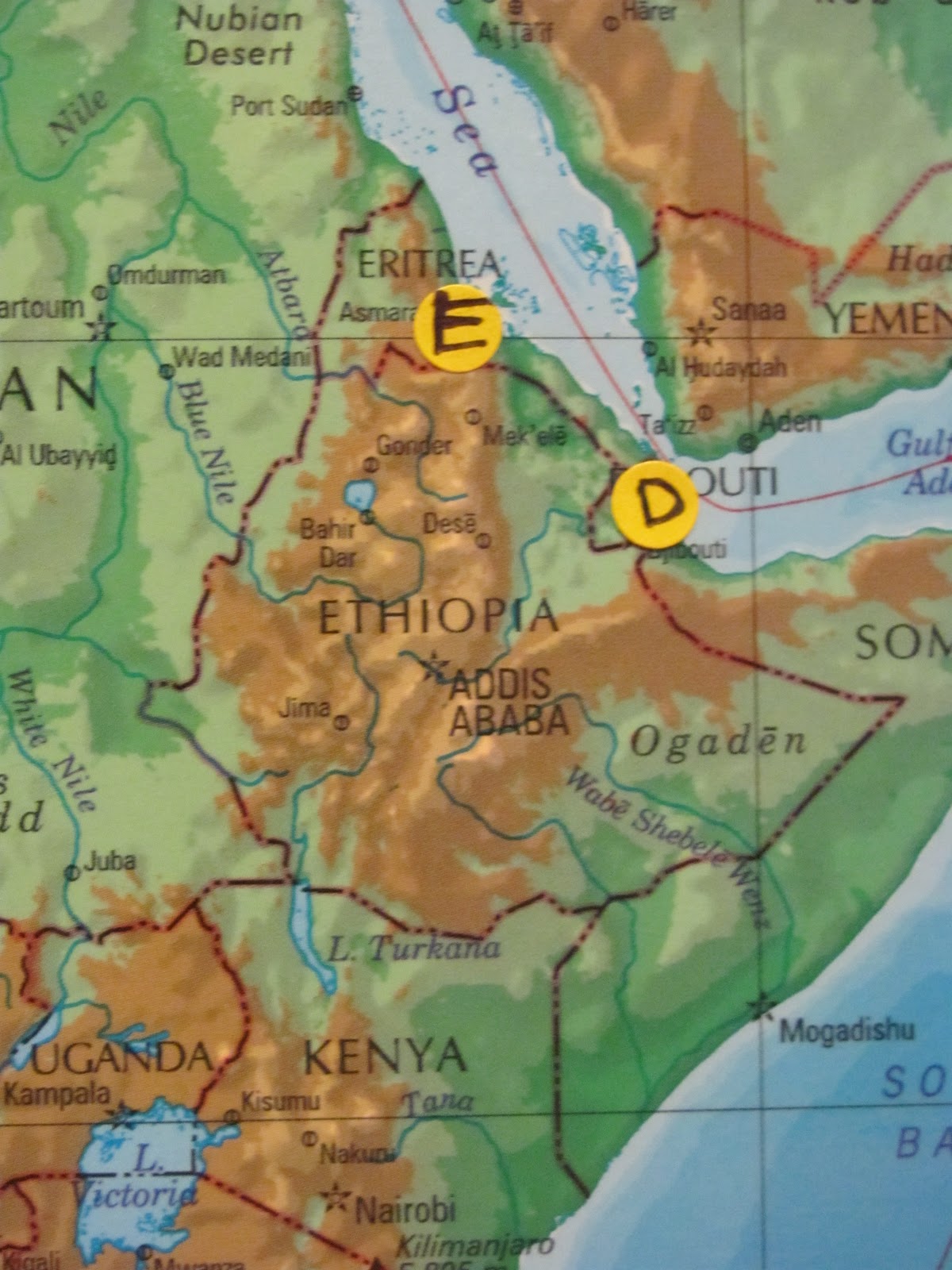
the yellow dots are where I've cooked!
Located on the north east coast of the African continent on the shore of the Red Sea, right next to Ethiopia and Djibouti, this country has an ancient history that is often referred to in mythic novels. Arabas, Turks, Egyptians, Italians and Ethiopians colonized and occupied the country, and so influenced the food. However, the main crops that form this culture's staples are ancient and include: cereals, barley, thaff, wheat, sorgum, millet and more recently, maize. Meat is considered a luxury and is generally reserved for special occasions. Please watch this video, sent to me by a reader (thanks, Simon!) to learn more about this beautiful country: http://www.youtube.com/watch?v=Mk7WGmsM2s0
The Injera Experiment
I decided to make Tsebhi, Spicy Shredded Beef, for dinner. Typically, it's served with Injera, a spongy bread that's used in lieu of utensils to scoop up the food - but that takes three days to make.  Not to worry though, I'm all over that...it's proofing now so I'll be able to serve it with the Ethiopian meal I'm planning for the weekend.  A warning to those who don't like to sweat while they eat - this dish is HOT, HOT, HOT!

The process for making injera is very much like making sourdough bread, where the starter needs to ferment over time. This may totally bomb, but I'll give it my best shot and report back!
Grated onion, ginger and garlic sautéed in butter and water till clarified
Strain out onion/butter mixture - voila...Tagelese Tesmi Herb Butter!

Spices for Berbere - Beautiful earth tones and the smell....exotic

Berbere (Chili) and Tegelese Tesmi (Herb Butter)

I had to convert cc's and grams to cups - that took a little brushing up on my math skills

Very good - hot and spicy, but not that pretty to look at - I served it with Indian Nan
Recipes

Tegelese Tesmi (Herb Butter)
  • 1 Cup unsalted butter
  • 1/3 Cup water
  • 2 Small onions, shredded
  • 2 Cloves garlic, crushed
  • 2 tsp. ginger, shredded
Put the butter and the water in a frying pan and heat them until the butter has melted. Add the other ingredients and simmer the mixture on a low flame for 30 minutes until the mixture stops stops skimming and the butter is clear. Do NOT stir the mixture. Seive the butter and allow to cool down in a well closed jam jar.

Berbere (Hot Chili Paste)
  • 2 tsp. cumin
  • 1 tsp. cadamom
  • 1/2 tsp. allspice
  • 1 tsp. fenugreek seed (couldn't find it)
  • 1 tsp. coriander seed
  • 8 cloves
  • 1 tsp. black pepper corns
  • 20 crumbled dried red peppers
  • 1/2 tsp. dried ginger
  • 1/2 tsp. turmeric
  • 3 TBSP. sweet or hot paprika
  • 1 tsp.salt
Put all ingredients up the salt in a frying pan and heat for 2 minutes, stirring constantly. Add the salt and grind the spices in a spice grinder.

Tsebhi Sega (Spicy Shredded Beef)
  • 2 Medium onions, chopped
  • 2 TBSP. vegetable oil
  • 1/9 Cup (that's right, 1/2 of a 1/3 of a cup) of berbere paste
  • 1/9 Cup tegelese tesmi
  • 1 tsp. chopped ginger
  • 1 tsp. chopped garlic
  • 6 large tomatoes, skinned (canned is okay)
  • 2 pounds beef or lamb - shredded
  • Salt and pepper to taste
Heat the oil in a frying pan and fry the onions until light golden. Add the berbere and the tegelese tesmi and some water if necessary and simmer it on a low fire. Add the ginger and the garlic after 10 minutes and the sliced, skinned tomatoes, some salt and pepper after another 5 minutes. After 15 minutes add the meat and simmer it until done. Add water as needed. Serve with injera or Indian Nan.

Final Assessment: If you like hot food, you'll love this. I liked it, but honestly, the lack of fresh vegetables and color makes the dish less appealing to me. I really wanted fresh, crispy vegetables and had to settle for tomatoes as garnish. I'd gladly eat this meal if served to me, but I don't think I'll make it again.

The Keys To Good Cooking by Harold McGee

Harold McGee

You may be familiar with Harold McGee from the monthly "The Curious Cook" column he writes for the New York Times, that looks at the science behind cooking. He has explained why adding water adds flavor to coffee and cocktails, why cilantro tastes like soap, for some and how to prolong the life of berries.

Harold McGee's book, On Food and Cooking is a classic reference and quite wonderful, but frankly a bit geeky. I've been fortunate to hear McGee speak a few times and I've always learned a lot. Last time he mentioned his upcoming book, The Keys to Good Cooking, and told the audience that it would help answer the questions home cooks have about the practical side of kitchen science.

I'll be reviewing the book when it comes out in October but in the meantime I got a peek at a few pages and gleaned these wonderful tips to help you succeed with braising:

Beware of recipes that call for an oven temperature over 180°F/80°C. Never let a braise or stew get hot enough to bubble when the meat is cooking. A closed pot in an oven at any temperature above the boiling point will come to the boil. At oven temperatures above 180°F/80°C, leave the pot open to allow evaporative cooling and produce a lower cooking temperature.

To braise or stew tough cuts of meat in a few hours, heat them at 180°F/80°C. They will develop the dry tenderness of standard braises and stews.

To braise or stew tender cuts quickly, or tough cuts over a day or more to keep them especially moist, heat them at 140-150°F/60-65°C°.

Here are links to my past posts on Harold McGee:

Gastronomic turns 10 with Harold McGee

Harold McGee & Shirley Corriher

Wednesday, September 1, 2010

Day 54! Equatorial Guinea(Malabo)(AF)-Banana Bake Breakfast - Up Next, Eritrea(Asmara)(AF)

Sometimes coming up with a good meal to represent a country is a challenge. Not because there aren't plenty of good things to cook and eat from each country, but time constraints can make it a little dicey.

Today's country, Equatorial Guinea in West Africa,  has many interesting foods. Typical to most West African countries in the continent, they use peanuts, tomatoes, cassava, yams and a few delicacies, like monkey meat, that isn't readily available in the US - even from an exotic meat vendor. Traditional breakfast foods include: boiled yams or cassava, bean cakes and ground millet porridge, which is very similar to grits.

To manage lack of time, and the demands of swinging back into work and school, I came across this simple but tasty breakfast dish, that is also frequently served up as a special treat. I had a bunch of bananas sitting on my counter that needed using up and I had all the other ingredients on hand - done deal.

Briefly, Equatorial Guinea sits on the coast of West Africa along with several islands in the Gulf of Guinea. In total, it's about twice the size of Connecticut, but is thousands of years older. The country has a long history of political unrest, corruption, coups and mismanagement of resources, leaving the rich wealthy, and the poor - well, poor.


Basic Ingredients
Arrange bananas in a spiral pattern

Browned and beautiful

Ready to eat alongside fresh pineapple - awesome

Banana Bake

  • 4-5 Banana's (not overly ripe)
  • 1TBSP butter
  • 3TBSP brown sugar
  • 1/3 Cup orange juice
  • Juice of 1/2 lemon
  • 1/2 Cup coconut (unsweetened if you prefer)


  1. Cut bananas in half, then in half again lengthwise
  2. Arrange in greased pie pan or casserole
  3. Drizzle lemon and orange juice over bananas
  4. Top with brown sugar and coconut
  5. Dot with butter
  6. Bake in 350 oven for 10 minutes until coconut is golden - you may opt to run under the broiler for a minute, but watch it carefully!

Serve alongside pineapple, melon or seasonal fruit.

Final Assessment: Very good, sweet and filling. If you like bananas and want something other than traditional breakfast fare, I recommend this dish...kids will love it too!

I'm writing for Epicurious again!

Epicurious
I am very happy to be writing for the Epicurious blog, Epilog again. I'm writing twice a week, and will be sharing some posts on intriguing flavor combinations. I hope you will check out my posts and please do leave comments and tell me what you think of my combos and how you would suggest using them. My first post is on the combination of rhubarb, cinnamon and rosewater. Coincidentally, the New York Times published a story about rosewater just yesterday.

I've been very busy lately writing posts for Epilog and for Amy & Amy Between Bites as well as pieces for Cheers magazine and Gastronomica, so hopefully that explains why it's been a little quiet around here lately. I am traveling quite a bit this month, but hope to post here again soon....

cheers,

Amy