-->

Friday, June 24, 2011

Day 144! Portugal - Barbecued Frango com Peri Peri (Chicken Peri-Peri) - Up Next, Qatar


Funny how things go. A few weeks ago I got a nice email from the Kalahari Pepper Company, wanting to know if I'd be interested in trying their Peri-Peri sauce in some of the African cooking I was doing. Never one to turn down free food of any kind (even if I don't know exactly what it is), I gratefully accepted. A week later, a package of mild, hot and extra hot Rhino Peri-Peri sauce showed up at my door. We immediately opened a bottle and tested it out. It was fragrant, spicy and a lovely orange color - perfect for dipping, adding to soups and stews and...marinating. By complete coincidence, while searching for a recipe for tonight's Portuguese meal, the first one I landed on was for barbecued chicken, marinated in Peri-Peri sauce. Turns out, Peri-Peri sauce is a regular staple used in both African and Portuguese cooking. I do believe the saucy Foodie Goddess was hovering over me today.

Known as Africa's hottest chili pepper, the Peri-Peri is grown in and exported from Botswana and Mozambique for the Kalahari Pepper Company. Not only that,  but a portion of the profits from the sale of Rhino Peri-Peri, goes to Save the Rhino International. Any time I come across companies that put out a great product and give back to the community or a cause, I'm thrilled to do business with them. Thank you Kalahari Pepper Company!

Settled since pre-historic times, Portugal is a southwestern country on the Iberian Peninsula. The country is bordered by the Atlantic Ocean and Spain. The Atlantic archipelagos of the Azores and Madeira are part of Portugal as well. In 29 BC, Rome integrated Portugal into it's empire as the provinces of Lusitania and part of Gallaecia. As a result, Portuguese culture and the language were strongly influenced by Roman settlers. Portugal claims to be the oldest nation state, and established itself as a global empire thanks to numerous maritime explorers who amassed territories in Africa, Asia, Oceania and South America (all of which are now independent countries).

Portuguese cuisine is somewhat similar to Mediterranean cooking, and tends to be rich, spicy and filling.  Once Portugal's colonial possession, African culinary traditions, particularly spices such as Peri-Peri, black pepper, cinnamon, vanilla and saffron are evident. Olive oil, garlic, coriander and parsley are all frequently used as well. The Portuguese people consume the highest amount of seafood in the world, and the country is  known for its culture of fishing. Chicken, linguica and pork also provide sources of protein. Tomatoes, onions, beans, cabbage, potatoes and kale are commonly eaten vegetables. Cheese, pastry, egg-based custards and wine also dominate Portuguese cuisine.


Barbecued Frango com Peri-Peri (Chicken Peri-Peri) - (Adapted from Lagos, Luz&Sagres Portuguese Recipes) - Serves 4-6

2 whole chickens
3 Tbsp. olive oil
1/3 cup salted butter
1/3 cup fresh squeezed lemon juice
Half a bottle of Piri-Piri pepper sauce
1 tsp. paprika
1 tsp. ground coriander
3 cloves garlic, peeled
3 scallions, sliced
1/4 cup parsley, chopped
1 piece fresh ginger, grated
1 Bay leaf
1/2 tsp. salt

Clean the chickens (removing any excess fat or giblets inside the cavity and thoroughly rinse, then drain and pat dry.
Place the bird, breast side down, on a cutting board and with a large, sharp knife, cut it through the center, but don't slice it in half.
Spread the bird out, then with a mallet, BEAT IT UP!! A few good smashes should do it! You want to be able to open the whole chicken flat on the grill.
Combine the remaining ingredients in a blender and pour half the sauce over the chickens in a large non-reactive pan or bowl. Cover and let marinate in the fridge for 4 hours (20 hours max if you want a spicier version). Refrigerate remaining sauce.
Place chickens, skin side up, on the grill of a gas or charcoal fire. Brush the chickens with some of the remaining marinade and cook until ready, continually basting the chickens, being careful not to have the flame so high that the skin burns before the inside is cooked. Give the chicken at least 15 minutes per side on a medium-low flame, turning often - you may need more time if the chickens are large. Poke a fork in the thickest part of the meat - when the juice runs clear - they're done. And don't worry, you can toss them back on the grill if need be!

Final Assessment: Oh yeah! Spicy, sweet, smoky, rich and tasty! I actually put them back on the grill after to cook another 10 minutes as the meat was just a little too pink for my liking. As long as you keep the flame or charcoal to a medium temp, you won't burn the meat. I only marinated this batch for 4 hours, but I may try over night next time. Awesomesauce!


(C) 2010-2011, What's Cooking in Your World?/ Sarah Commerford/All Rights Reserved 


Thursday, June 23, 2011

Louisiana Gulf Shrimp

Louisiana gulf shrimp
Help! I'm undergoing gulf shrimp withdrawal! On my Louisiana Seafood adventure I ate shrimp every single day and never got tired of them in the least. In Louisiana there are white shrimp, brown shrimp and freshwater shrimp. I particularly liked the flavorful brown shrimp I tried, though they are less popular than the larger white shrimp.

Shrimp from the gulf are sweet and succulent and perfectly safe to eat. At the Sustainable Foods Institute (part of Cooking for Solutions at the Monterey Bay Aquarium) I spoke with scientists who told me that the shrimp population came back quickly after the oil spill in the gulf and the testing has not shown any signs that the seafood is contaminated. Fortunately Louisiana gulf shrimp are available all over the country and are really worth seeking out for their superior flavor and texture and because they are harvested in a more sustainable way than the cheap shrimp you find imported from Asia.

So how many ways are there to eat shrimp? Probably more than I can count, but here are my absolute hand's down favorites from the trip:

Barbecue shrimp from GW Fins, upper left hand corner. Now barbecue shrimp in Louisiana are not "throw a shrimp on the barbie" Australian shrimp, or doused in Texas style barbecue sauce, they are cooked in butter and spices and positively delicious. I found this recipe online, so you can try making them at home. Now if I could just get my hands on the savory Jazzmen rice pudding recipe that accompanied the shrimp...

Shrimp boil is next, shown in the upper right hand corner. But here's what I learned about shrimp boil. It's shrimp poached gently in a spiced broth, off the heat! The shrimp never get boiled, just the seasoning mix and cooking liquid. This was news to me, but explains why you end up with such juicy shrimp, it's probably the most gentle way to cook them. Cooking them in the shells helps prevent them from overcooking and yet they do take on the flavor of the "boil."

Shrimp remoulade is in the bottom right hand corner, as served at Mandina's. My thanks to Pim for introducing me to this neighborhood gem and my other charming and enthusiastic dining companions–Adam aka the Amateur Gourmet and Chichi who writes for Serious Eats. The secret to this dish was of course the remoulade sauce, which was heavily spiked with horseradish. Yum! Horseradish makes pretty much everything taste better. Especially remoulade sauce.

Last but not least, fried shrimp (and some oysters too). This was another dish at Mandina's and while I never got my hands on a po' boy, this was the same thing, just no bread. More shrimp! The folks in New Orleans know how to fry their food so every thing is crisp and greaseless. Seriously, they are deep frying experts and I am happy to leave the frying to them.

What's your favorite way to enjoy shrimp? Shrimp etouffée? Shrimp bisque? Is there a particular NOLA style shrimp dish you love?

My thanks to Louisiana Seafood for sponsoring this trip. It was a blast!

Wednesday, June 22, 2011

Day 143! Poland - Pączki - Polish Donuts with Rose Jam Filling - Up Next, Portugal


Somewhere in my travels, I recently read that donuts were the new cupcake. Need I go on? While I love a good cupcake, they've always seemed a little precious - so much ado about a little cake that generally has way too much sweet and fussy frosting for my liking. But oh, the simple donut; where to begin? Just thinking about donuts conjures up memories of Mike's Donuts -- a real-deal, old-school coffee shop located on Mission Hill in Boston, where my husband's family has lived for decades, and where our sweet children were born. Family owned and operated, Mike's is a meeting place for neighborhood folks and passers by on their way to work or school. Steaming hot coffee and racks of sugared, filled, plain, frosted or glazed donuts fill the shop with the heavenly scent that only a coffee-donut-sugar combo can create. Close your eyes for a minute and let your olfactory memory take you there - got it?

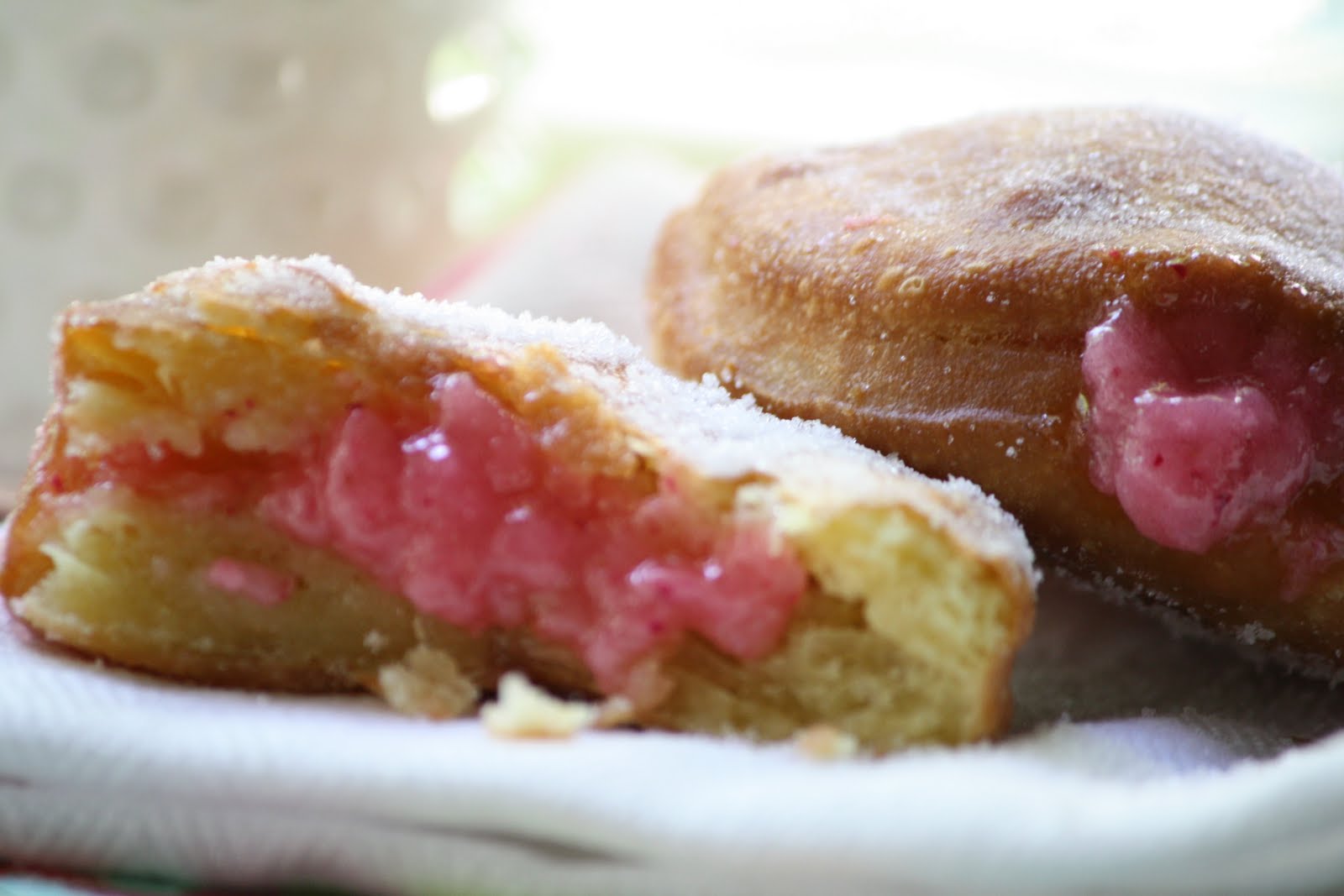
So while searching for a recipe to represent Poland, I came across numerous recipes for Pączki - Polish donuts, many with rose jam filling. To make the rose jam, I clipped a variety of roses I have in my back yard. A little water, a little lemon juice, lots of sugar, some pectin and presto:  sticky, sweetly scented and pink rose jam. I used all the pectin recommended in the recipe, but the next time I make it, I'll use a little less so it's not quite so thick. Any roses will do, but be sure to use roses that haven't been sprayed with chemicals. As for the donuts, it was very hot and humid today, so the dough did not rise as much as it would have on a cooler, dryer day. No matter, although they're not especially healthy, they were beautiful, delicious and, let's face it,  sometimes you just have to summon a heaping dose of denial and let yourself indulge in a good donut.

A central European country, Poland is bordered by Germany, Czech Republic, Slovakia, Ukraine, Belarus, Lithuania, the Baltic Sea, and Kaliningrad Oblast, a Russian exclave. Poland's existence dates back to the adoption of Christianity in 966, but the Kingdom of Poland was formed in 1025. In 1569, the Polish-Lithuanian Commonwealth was formed, until 1795 when the lands were partitioned again. Poland regained independence in 1918, but in 1939,  Poland was invaded by Nazi Germany and the Soviet Union, triggering WWII. Following revolutions in 1989, communist rule was overthrown and Poland finally became a unitary state, made of of 16 voivodeships. Despite wars, economic hardships and political changes, the country has maintained cultural wealth and rich traditions.

Culinary traditions in Poland have evolved over the years to due to many changing circumstances. However, food in this country generally shares similarities with other central and eastern European countries. Much Polish food takes time to prepare and involves numerous steps. Beef, chicken, pork and some fish are primary sources of protein, while a variety of winter and root vegetables are used in soups, stews, and fillings for dumplings. Cream and eggs are used in abundance, as are a wide range of sweets and cakes, some topped with lovely poppy seeds. Pączki - polish donuts with or without filling, are traditional eaten on Fat, or Shrove Thursday, the last Thursday before Lent begins which welcomes the winding down of Carnival season (as Fat Tuesday and Mardi Gras).

Rose Jam


Pączki - Polish Donuts 


Rose Jam (Adapted from cooks.com)

1 cup rose petals (free of any chemicals or pesticides)
3/4 cup water
Juice of 1 lemon
2 1/2 cups sugar
1 pkg. powdered pectin and 3/4 cup water

Pick clean, chemical-free roses.The color roses you chose will determine the color of the jam.
Pull the petals from the roses and clip off the white ends.
Pack a one cup measuring cup with rose petals.
Put petals in a blender, add water and lemon juice.
Blend until smooth, then gradually add sugar. Run blender until sugar is disolved.
In a pan stir pectin into water. Bring to a boil and boil hard for 1 minute, stirring constantly.
Pour into rose mixture, 1/8 cup at a time with the blender running on low, until you achieve the desired consistency.
Pour into clean glass jars, cover and refrigerate. Will keep for one month.

Pączki - Polish Donuts (adapted from a recipe on about.com)

1 1/2 cups warm milk (no warmer than 110 degrees)
2 packages active dry yeast (remember to proof yeast before you begin)
1/2 cup sugar
1 stick, sweet unsalted butter at room temperature
1 egg, at room temperature
3 egg yolks, at room temperature
1 tsp. vanilla
1 tsp. salt
4 1/2 - 5 cups all purpose flour
1 gallon oil for deep frying
Granulated sugar for sprinkling, optional
Confectioner's sugar for dusting, optional
Fruit jam for filling, optional

1. Add yeast to warm milk, stir to dissolve and set aside. In the bowl of a stand mixer fitted with a paddle attachment  cream together sugar and butter and beat until fluffy. Beat in eggs, vanilla and salt until well incorporated.
2. Still using the paddle attachment, add 4-1/2 cups flour, alternating with yeast-milk mixture and beat for 5 or more minutes until smooth. If the dough will be slack and have a sheen to it, but if it looks too sticky, add the remaining 1/2 cup flour, but no more.
3. Place dough in a greased blow, cover and let rise until doubled in bulk (1 to 2-1/2 hours). Punch down and let rise again.
4. Turn dough onto lightly floured surface. Pat or roll to 1/2-inch thickness. Using a 3-inch biscuit cutter, cut as many rounds as you can, gathering scraps and re-rolling to cut and use all the dough.
5. Heat oil to 350 degrees in an electric or heavy skillet. Place donuts top-side down in the oil a few at a time and fry 2-3 minutes and fry until golden brown. Flip them over and fry another 1-2 minutes until golden brown. Be careful not to let the oil get too hot as it will burn the outside of the donut before the center is fully cooked.
6. Drain on paper towels and roll in granulated sugar will still warm.
7. To fill donuts, poke a hole in the side of the donut (I used a chopstick), fit a pastry back with a medium sized tip, and pipe filling into the center of the donut.


(C) 2010-2011, What's Cooking in Your World?/ Sarah Commerford/All Rights Reserved 

Saturday, June 18, 2011

Day 142! Philippines - Sea Bass Kinilaw (Ceviche) - Up Next, Poland


The credit for tonight's Filipino Kinilaw (pronounced ki-ni-la-o) goes entirely to my friend Sylvie, who I met through this blog and who so generously gave me this amazing recipe. Except for substituting sea bass for mackerel (because it wasn't available), and not peeling the tomatoes and peppers, because I was lazy, I followed the recipe exactly as written. Words cannot describe how divine this dish is. Perhaps one of the coolest things about writing this blog, is that wonderful people I've never met agree to help me along the way. Sylvie and her husband who are French, are expats who lived in the Philippines for 6 years, followed by 2 years in Colombo, Sri Lanka. Currently, they live in Latvia, where they are raising 2 young children. In my wildest dreams, Sylvie and I will get to meet some day and share a lovely meal. Until then, technology makes our awesome cross-continent friendship possible.

Located in South East Asia, the Philippines lie in the Western Pacific Ocean. The country is an Archipelago of 7,107 islands with 3 distinct geographic divisions. To the country's north across the Luzon Straight is Taiwan. To the west across the South China Sea is Vietnam. The Sulu Sea to the southwest lies between the island country of Borneo, and the the south, the Celebes Sea separates it from Indonesia. Because the country has a tropical climate and is located on the Pacific Ring of Fire, it is prone to earth quakes and typhoons. Concurrently, the climate  provides the Philippines with one of the richest biodiversity resources in the world.

An ethnically diverse country, Filipino cuisne is a mixture of Malay, Chinese and Spanish traditions. As I mentioned, the country has three distinct regions whose cuisine varies quite a bit. The following information comes courtesy of Sylvie in it's entirety - She did all the work on this one, and I can't thank her enough.


1) LUZON:
Manilla: Being at the center of the country, Manilas cosmopolitan atmosphere is reflected in the flavors of its food (gambas, roast suckling pig, "lechon" or paella)
Central Luzon: Dishes from its vast plains, swamp plains and rivers (caldereta, relleno and adobo)
Northern Luzon:  Arid lands and mountains/Ifugao rice terraces, hence basic but nourishing cuisine (baradibud, a fresh vegetable stew in sweet potato broth, or pinakbet, a vegetable stew with crisp pork belly.
Southern Luzon: Fertile are thanks to the taal volcano, Batangas region is know for its beef industry. Its economy depends to a great extent on the coconut tree. Kesong Puti, a popular white cheese made from carabao's milk (water buffalo), far cousin from mozzarella, is produced there.
Palawan region: Characteristic is the use of green mango, adding sour taste to otherwise generally sweet cuisine.
Bicol region: Characteristic is the use of the sili, or hot chili pepper (eg. Bicol Express, named after the train from Manila)
2) VISAYAS:
Central Visayas: Great variety of seafood, often prepared marinated in vinegar, broiled or boiled. Chinese influence is strong in Cebu, but also Spanish, especially in desserts.
Western Visayas: Cane plantations built fortunes, so sweets are an important part of their cuisine. Marinated raw fish and seafood is much flavored,
3) MINDANAO: (The only Muslim part of the country, the rest being Catholic)
Davao: Specialty is broiled tuna jaws. This region produces most exotic fruits, including the special Durian.
Zamboanga: Very strong Spanish influence (callos, tripes), is also famous for its crabs.

Sea Bass Kinilaw (Ceviche) - Recipe from Sylvie

2 1/4 lbs. (1 kg) Taguigue (Spanish Mackerel) - I used Sea Bass
1 pound (600g) calamansi (small green round lemons) - I used limes
4 garlic cloves, finely minced
2 onions, finely minced
4 fresh tomatoes, peeled, seeded and diced
2 Tbsp. fresh ginger, minced or grated
3 bell peppers (red or yellow), peeled , seeded and cut into strips
1/3 cup (100 ml.), coconut milk, preferably fresh, but unsweetened canned will do
Salt and freshly ground black pepper to taste.

Cut the fish into small cubes, marinate in calamansi/lime juice for 1 hour.
After 1 hour, add all the remaining ingredients.
Chill before serving. Serves 4, usually as a starter.
No wine will match due to acidity, but a cold beer is perfect

Final Assessment: One of our all time favorite meals so far. The combination of lime, ginger, onions and all the accompanying peppers is sweet, sour and crunchy, while the mild fish "cooked" in the lime juice is tender and succulent.  Luckily, we have leftovers which will be tomorrow's lunch!

(C) 2010-2011, What's Cooking in Your World?/ Sarah Commerford/All Rights Reserved 

Bourbon for Father's Day

I'm just back from Bourbon Street, and I have bourbon on my mind. Of course, in New Orleans I drank Sazeracs, and the flavor of the city is really herbsaint as far as I'm concerned. But I'm thinking about bourbon and the young people I met in Louisville last Spring who told me that bourbon was what their granddaddies drank. It took them a while to come around to it, but they have now embraced it as their own.

Maker's Mark distillery
Even though my father doesn't drink it, bourbon just seems like the quintessential spirit for dad. In my visit to bourbon country, I learned the distilleries were all pretty much family ventures, though now mostly owned by conglomerates. Even if you don't drink bourbon, a visit to this beautiful part of the country outside Louisville is a treat. I was a guest at the Maker's Mark distillery in Loretto which feels more like a national park than anything else. Historic wooden buildings with touches of their trademark red are set against a lush green backdrop. The tour of the distillery is very worthwhile. It's so old fashioned and small scale you might be surprised, I loved seeing the buckets of yeast and beautiful copper distillation pots.

46

Maker's Mark is made from corn, barley and local wheat. It is smooth and has featured prominently in my recipe development efforts. It has a sweetness and rich caramel and toffee notes with a hint of citrus. If you like Marker's Mark, try 46, which is also made from Maker's Mark, but is aged with more specially charred oak staves, it's a bit higher proof but still mellow and has more spice and vanilla to it.

American whisky glass
There are lots of ways to enjoy bourbon, but if you are drinking it straight, by all means, check out the gorgeous American whisky glassware from Villeroy & Boch. The feel of these heavy glasses in your hands and the way the aroma builds and wafts up to my nose convinced me, these glasses are a must for bourbon purists. Villeroy & Boch make a whole line of whisky glasses for a range of whiskies and cocktails so you can get just the right glass to go with your drink. My thanks to Villeroy & Boch for sending me some samples to try out.

The Kentucky Bourbon Cocktail Book
My favorite bartender in Louisville, Joy Perrine wrote the definitive book on bourbon cocktails, The Kentucky Bourbon Cocktail Book. Her recipes are layered and balanced and introduced me to so many new ways to enjoy bourbon. She combines it with everything from amaretto to vermouth. The section on creating bourbon infusions explaining how to use herbs, spices and fruits to flavor bourbon is particularly intriguing.

Thursday, June 16, 2011

Day 141! Peru - Peruvian Grilled Chicken- Pollo a la Brasa - Up Next, Philippines


It just so happens that while standing in line at the grocery store last week, I spotted the Gourmet Grilling issue. Drawn in by it's mouth-watering "this burger will change your life" cover shot, I reached for the glossy mag, altogether ignoring People, Star and Us.  In what I can only imagine must have been a karmatic twist of fate, I opened the magazine to Peruvian Grilled Chicken, or Pollo a la Brasa,  the very country I was planning to cook in, but had no recipe for. Aside from the gorgeous photographs, I fell in love with the recipe for it's simplicity and the combination of clean flavors in the marinade. Wait...is it socially acceptable to lust after a recipe? Who cares; that's how I feel, and I'll live in secrecy no more.

Located in western South America, Peru is bordered by Ecuador, Columbia, Brazil, Bolivia, Chile and the Pacific Ocean. A multi-ethenic country of Amerindians, Europeans, Africans and Asians, Peru is also home to one of the oldest civilizations in the world, the Notre Chico as well as the Inca Empire. Spanish, Quechua and other languages are spoken in Peru. As diverse as the population is, Peru's geography is unique as well, encompassing the plains on the Pacific coast, peaks of the Andes and the tropical Amazon forest. Peru gained independence from the Spanish empire in 1821, but continues to struggle with on-going political and fiscal instability today.

Cuisine in Peru is influenced by the many travelers and settlers who have traversed the country from Spain, China, Italy, West Africa and Japan. The country's primary staple foods are corn, potatoes and beans. Quinoa, kiwicha, chili peppers,  tubers and rice as well as chicken and fish round out the basics. Interestingly, Peru has one of the most prolific and genetically diverse variety of crops, including, but not limited to 35 varieties of maize, 15 species of tomatoes, 200 types of potatoes and 150 varieties of sweet potatoes.


Peruvian Grilled Chicken (Adapted from Gourmet)

1/3 cup soy sauce
2 Tbsp. fresh squeezed lime juice
5 garlic cloves
2 tsp. ground cumin
1 tsp. paprika
1 tsp. fresh oregano
1 Tbsp. canola oil
1 whole chicken, quartered or cut up
Lime wedges for garnish

Marinate Chicken
Blend soy sauce, lime juice, garlic, cumiin, paprika, oregano, 1/2 tsp. pepper and oil in a blender.
Put chicken in a large ziplock bag and add marinade. Seal bag and turn to coat. Marinate, chilled 8-24 hours.
Grill Chicken
Prepare grill for indirect-heat, cooking over medium-hot coals (medium-high heat for gas).
Discard marinade, oil rack and grill chicken over area with no coals (or over turned off burner), skin side down first, covered, turning over once, until cooked through - about 15-18 minutes on each side.**
Add more charcoal if necessary to maintain heat.
**I did not follow this exactly - I simply let the coals burn down, and then -cooked, turning frequently to avoid burning.

Serve with potato salad and green salad. And, if it's an accompanying beverage you crave, beer is good, but a Lychee-Pomegranate Margarita is better :)

Final Assessment: Deluxe! This dish has earned itself regular rotation on my summer grilling menu. Garlic, lime, cumin, paprika and oregano make for a wonderfully aromatic and flavorful marinade, and if you have the patience to let the chicken marinate overnight, it'll fall off the bone with each bite.

(C) 2010-2011, What's Cooking in Your World?/ Sarah Commerford/All Rights Reserved 

Wednesday, June 15, 2011

Day 140.1 - Lychee-Pomegranate Frozen Margarita


How could I walk by something as prehistoric and exotic looking as Asian lychee fruit without stoping to scoop up a pound? It didn't matter that I had no idea what to do with them; their beautiful crimson-red color and unusual reptilian-like skin was simply impossible to resist.  A quick trip to the produce section to pick up some pomegranate juice - a household favorite we mix with seltzer, and  I had the beginnings of an idea buzzing around in my brain. Sorbet? Flan? Ice cream? Noooo...because today the sun came out for the first time in a week, and MY Boston Bruins are going to win the Stanley Cup tonight. So to celebrate these momentous events, a batch of Lychee-Pomegranate Frozen Margaritas is in order.

I admit that a fruity, pink margarita is kind of a girly cocktail to be mixing up for a hockey game, but rest assured, there's plenty of beer in the fridge for overtime.  Full of vitamins and mythical curative properties (okay, so maybe the tequila cancels that out), pomegranate juice also serves to color the margarita a heavenly shade of pink (magenta if you add more) that even a burly, bearded  Boston Bruin would appreciate.  Plus, my husband thinks it's the greatest thing on earth to be welcomed home from work with a cocktail as a 1950's housewife would have done. I was never any good at memorizing mathematical formulas - in fact, I flunked elementary and high school math with spectacular consistency, but this equation I have down pat: Margaritas+Bruins+Happy Husband = Trifecta
Now go get your man...or woman.


Lychee-Pomegranate Frozen Margaritas

1/2 cup chopped lychee
1/8 pomegranate juice (added gradually until you achieve the desired color)
2 cups crushed ice
1 cup lime juice
1/3 cup triple sec
1/3 cup tequila (blanco)
1/8 cup simple syrup (optional, only if you like a sweeter drink)
Lychee to garnish
Thinly sliced limes and lemons, for garnish
Salt, for rim of glass

Blend first 6 ingredients in a blender until smooth - 7 if you opt to use simple syrup (but I don't think you need it)
Lime and salt the rim of the 2 glasses
Pour mixture into glasses and garnish with lychees and lime.

Serve with tortilla chips and  fresh guacamole and call it dinner.

Final Assessment: This is probably one of my all time favorite margaritas. The delicate, sweet taste of the lychee comes through and is complimented by the tart flavor of the lime and pomegranate. I personally don't think simple syrup is necessary, but if you like a sweet drink, by all means add it.

(C) 2010-2011, What's Cooking in Your World?/ Sarah Commerford/All Rights Reserved