-->

Sunday, April 8, 2012

Vegetable Fried Wontons


Since making our pork flower dumplings a couple weeks ago, those leftover wonton wrappers have just been calling out to us. “Please use me, for the love of god please use me!” could be heard every time we opened the refrigerator door.  These exclamations probably rang so clear because there they were, right there on the top shelf on the side of the fridge door.  Not hidden way in the back or in one of the drawers or lost under a pile of stuff.  Right there on the side of the door.  So, being that the refrigerator door is opened multiple times a day, we caved.  This time, we went veggie.  We minced up some sturdy vegetables like jicama, carrot, and celery, gave them a soak in a savory sauce, and then deep fried them to get a crunchy golden exterior.  The really neat thing is that they are more flavorful than almost any meat dumpling I’ve had!  Some cinnamon sprinkled on top adds a nice final touch and helps round out the sweet, savory inside with a bit of fragrant spice on the outside. 

Ingredients 
1 scallion, minced
¼ cup minced jicama
¼ cup minced carrot
¼ cup minced celery
2 teaspoons minced ginger
3 cloves garlic, minced
2 tablespoons soy sauce
1 teaspoon oyster sauce
½ teaspoon honey
1 teaspoon rice wine
2 tablespoons chicken broth
16-20 wonton wrappers
canola oil, for frying
pinch of cinnamon
sweet and sour sauce, for serving

Instructions
Place the scallions, jicama, carrot, celery, ginger, and garlic in a medium-sized bowl.  In a small bowl, whisk soy sauce, oyster sauce, honey, rice wine, and chicken broth.  Pour the liquids over the vegetables.  Let the mixture sit for at least 30 minutes.  Take a wonton wrapper and place in the palm of your hand.  Place ½ tablespoon of the mixture in the middle.  Dab water around two adjacent sides of the wrapper, then bring up the other two sides of the wrapper to form a triangle.  Place canola oil in small pot and heat to 325-350 degrees.  Fry 4-5 wontons at a time until golden brown, about 5-8 minutes.  Place on paper towels and then fry another batch.  Sprinkle cinnamon on the wontons, and then serve with sweet and sour sauce.

Friday, April 6, 2012

Day 189.5 Braised Squirrel Aurora


Squirrel. Squirrel?!! Those little b*st*rds that chewed through the fascia board on our 140 year old house, got in the walls and partied for a week straight before we caught and "relocated" them? Yes, squirrel. And why not?

American Red Squirrel -
Photo Courtesy of Animal Galleries
Now, I can fish (although I've been known to cast out and catch my husband's hat - or shirt - or arm). And, nothing - I mean, nothing in the wild kingdom scares or grosses me out. Add to that, my long-held belief that overall, we as a nation are way too removed from the source of what eat - meat, vegetable or tofu.  Enter, Alex and his family - friends, avid hunters and adventurous eaters. After telling Alex that I'd been thinking about learning how to hunt small game, he mentioned that he just happened to be heading north, and offered to bring back squirrel. Which he did; Dressed, skinned and on ice. I asked Alex to tell me a little about himself, and this is what he sent me. It's so beautifully written that I've included his "essay" as is - no editing.

These squirrels were shot in Gilmanton NH. It's just south of Laconia and Belmont, about 5 miles south of the semi popular Gunstock Ski area. (It's also the town that the novel "Peyton Place" was written largely about. The book’s author Grace Metalious is still buried there.) There are forests there now, but 150 years ago, it was all clear farmland. They are in fact American red squirrels. These squirrels are widely distributed throughout North America. They survive mainly on pinecone seeds, and they are more common in the Northeast these days as pine forests have sprung up in areas that used to be hardwood forests. Their calls are quite distinctive. They chirp like birds and chatter at intruders.

To hunt them I used a Ruger 10/22 semi auto rifle, using 22 LR ammo. 22 rimfire is probably the most popular round used on small game, and nearly everyone learns how to shoot with it. When it comes to hitting the squirrels, it depended on where I found them and what they were doing. I found one in an area thick with pine, and it was only 5 yards away. Sometimes when alarmed they hold up against a tree and don’t move in an effort to remain invisible. If you see them then they are easy to hit. When you see them up high in the trees though, they tend to race from branch to branch and they are nearly impossible to hit.
Alex, on the move

In order to dress them, I first slit the bellies open up to the breast taking care not to puncture the intestines. The idea is to cool the meat as quickly as possible in order to avoid spoilage of the meat. Then I pulled out the internal organs. This procedure is standard for all game, with variations given to different animal types. (For instance, remove the feathers first when dealing with birds.) I then removed the heads and tails. Using the area near the open neck, I pinched the skin layer and peeled it back. From there I peeled back the skin and pulled it off entirely. Note that I am still somewhat of a self taught amateur, so my technique is not perfect. This is the first time I have dressed squirrels and I have yet to eat them.

I have been hunting of a sort all my life and I suppose I was no more “taught” how to hunt then I was “taught” to speak and walk. I used to accompany my uncle on small game and deer hunts starting at the age of three. At about eight years old my father and uncle taught me to shoot and I started hunting small game, mostly small rodents (including squirrels) in order to keep them out of my uncle’s garden. They filled me in on the basics. Shoot a deer here, you can find them in areas like this, don’t move a muscle when stand hunting, walk slow and the like. I taught myself the rest. I shot my first large animal, a turkey at age 17 and my first deer this fall.

Turkey is Alex's favorite thing to hunt
Far and away my favorite thing to hunt is wild turkeys in the spring. Most hunters would say deer, but deer hunting is a lot of sitting and waiting, and a lot of seeing nothing, even in a good year. Turkey hunting by comparison is more active. You call the male birds in using mating calls, and you hear them make their famous “gobble” as they talk back to you. You feel a lot more involved with the animal, which in my mind makes it all the more special. Oddly enough though, my favorite tool is my deer rifle, a bolt action Sauer 200 in 308 Winchester, with a Schmidt and Bender scope. It was a 16th birthday gift from my uncle, and I lovingly call it “Vera.”

I am one of those guys that see all animals as equal, equal to me and to other animals. I see no difference between a trout and a turkey, or a dung beetle and a deer. Therefore the things I will not hunt comprise a very basic list. I will not hunt anything protected by law, and that includes the two things that I would not hunt if otherwise. Those two things are bats and owls. Owls are my steadfast hunting buddies, as there is always one around when I’m out in the woods, and I find bats fascinating. Not that I’m not fascinated by the animals I do hunt, but bats are special to me for some reason. I can’t fully explain it.

If there was one final thing to say it would be this. There are a lot of folks out there who don’t exactly take kindly to what it is I do. They seem to think I “hate” wildlife. Nothing could be further from the truth. I love wildlife. I’d do anything to preserve it. I just express that love in a different way. The way I see it, I’m just doing what I see as a natural human activity, something we have done for millions of years. By doing it this way, I yearn for a stronger connection to wild. I don’t just observe nature. I’m a working part of nature.

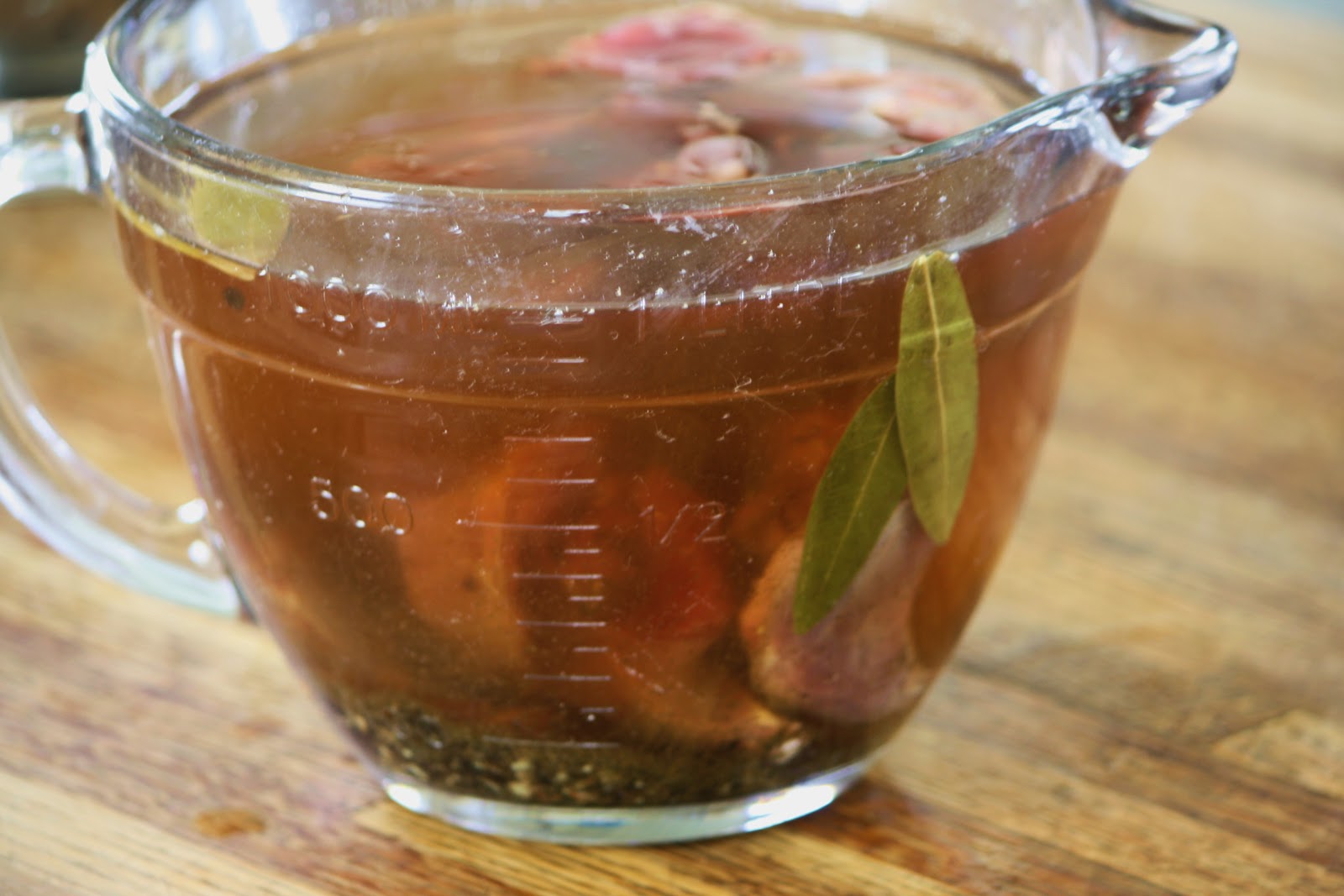
The brine: cracked pepper, salt, thyme, bay leaves and water
Combine in a sauce pan, cover, bring to a boil and cool to room temperature
 Add meat, cover and refrigerate for 6-8 (but no more or the meat becomes uber salty)
Cutting a squirrel to serving size pieces is similar to cutting up a rabbit or chicken - only tiny
Toasted almonds and lots of garlic are chopped and added to the sauce later on
 Green Spanish olives add a rice, piquant flavor to the sauce
 Slice a 1/2 a whole onion; grate the other half for the sauce (I forgot the pix of of the hot pepper
 1 cup of white wine, 1/2 cup of chicken broth
 I used baby potatoes
Dredge squirrel in flour and brown in olive oil
Bring to a boil, then pop in the oven
 Behold - Braised Squirrel Aurora

To view the recipe and technique in its entirety, please Hank Shaw's most excellent website, Hunter Angler Gardner Cook,   Honest Food 


© 2010-2011, What's Cooking in Your World? Sarah Commerford/All Rights Reserved

Thursday, April 5, 2012

Carbonara Dip, with Brie and Pancetta


Once upon a time in a far away land called Dana Point, CA, there lived a Seth and a Jenn and a toddler named Max.  All three of them loved to dip things. One day Seth came home raving about a pizza he had for lunch.  That pizza was called Carbonara Pizza.  He wanted to recreate that amazing dish.  However, they were very far away from making acceptable pizza at home.  So instead, they did what came naturally.  They made a dip.  And that is the story of how Carbonara Dip came to be, and all three dip aficionados munched happily ever after.

Ingredients
Carbonara Dip:
1 tablespoon olive oil
1 tablespoon butter
3 tablespoons cubed pancetta
1 shallot, minced
3 garlic cloves, minced
3 tablespoons white wine
8 ounce wedge of brie
6 ounces cream cheese
1 ½  teaspoons Worcestershire sauce
generous amount of freshly ground black pepper
4 tablespoons chopped basil, plus more for garnish
¼ cup Parmesan cheese

Baguette Dippers:
1 baguette, sliced
¼ cup olive oil
freshly ground black pepper
kosher salt
1 tablespoon chopped basil

Instructions
To prepare the dip: Heat oven to 375.  Heat olive oil and butter over medium-high heat and crisp the pancetta cubes, about 3 minutes.  Turn heat down to medium-low and add shallot and garlic.  Saute until shallots are soft.  Deglaze with the white wine, being sure to get any of those crispy brown bits off the pan.  Add the cheeses and melt everything together.  Stir in the Worcestershire sauce and black pepper.  Add the chopped basil and transfer the mixture to an oven-proof pan to bake.  Sprinkle the top with Parmesan cheese.  Bake for about 15-20 minutes, until the top is golden-brown.  Stir and sprinkle more basil, if desired.

To prepare the baguette dippers:
Heat oven to 350.  Place slices of baguette on baking sheet.  Brush each slice with olive oil, then sprinkle with black pepper and salt.  Repeat for each slice.  Bake for about 7-10 minutes, until the baguette slices have toasted.  Sprinkle chopped basil over slices.

Wednesday, April 4, 2012

Day 189! Uruguay~Chivito Sandwich - Up, Next, Uzbekistan


At last, the declared dude-favorite of all the countries I've cooked in thus far! The manly Chivito sandwich wins the blue ribbon seal of approval from my husband and sons alike. Packed with three different kinds of meat, cheese and egg, this sandwich must be eaten with two hands while bending slightly forward from the waist over a plate or paper towel - or both.  The Salsa golf sauce, a combination of ketchup and mayonnaise my boys have always been partial to, puts the perfect finishing condiment touch on the Chivito, the national sandwich of Uruguay. Depending on the recipe, there are many slight variations of this street snack that include the addition of pickles, olives and peppers to name just a few, but I skipped those and kept to what seemed like the most consistent recipe combination. I did however have to opt for thinly sliced sirloin steak tips (props to my butcher for doing the work for me!) instead of pricey fillet mignon which is the authentic cut called for, since the cost was a total budget-buster. Ah well, necessity is the mother of invention.

Map Courtesy of Lonely Planetwww.lonelyplanet.com
Officially the Republic of of Uruguay, the country is located in the southeastern part of South America, and shares its borders with Argentina and Brazil. Uruguay is the second smallest country in South America and was the original home to Charrua Indians who inhabited the beautiful land before European colonization. Montevideo, the country's capital was founded by the Spanish during the 18th century as a military stronghold and was explored by numerous seafarers. Between 1811-1828, the country was torn in a three-way struggle with the colonies of Spain, Argentina and Brazil, but finally gained its independence. This gorgeous country is known for pristine beaches, interesting cities, great food and vibrant night life. One of the most economically developed countries in South America, Uruguay was the first country in this part of the world to legalize same-sex and different sex civil unions and gay adoption. Right on.

Food in Uruguay has been influenced by the Spanish who first introduced cattle. Mediterranean influences are also infused in the food from countries such as Italy, Spain, Portugal, France, Germany, Britain, Africa and to a lesser degree, ancient indigenous traditions. Barbecue, or Asado (mixed grill), is one of the country's most impressive and delicious offerings, along with the chivito (meaning 'little goat') sandwich, pasta, sausages and rich desserts. Dolche Leche (sweet and creamy) is used to fill cakes, cookies and to make custards. Grappamiel,  a popular drink that combines alcohol and honey can be found throughout the country - I'm really curious about what that tastes like!

Sliced tomatoes, onions and lettuce 
 Sliced fresh mozzarella 
 Onions, sauted in a little bacon grease
 Saute sliced beef and ham
 Use good crusty rolls like these that will hold up to this hefty sandwich
Salsa Golf Sauce - a mixture of mayonnaise and ketchup is a popular combination in Uruguay
 Spread Salsa Golf on roll
 Layer lettuce, beef, bacon, ham, tomato, onions and mozzarella, then broil just until cheese melts
 My husband gives Chivito an enthusiastic two thumbs up!

Chivito (Adapted from About.com)

4 very large sandwich buns (large ciabatta rolls are good)
2 beef filet steaks, or 4 thin slices of grilled steak
8 pieces of bacon
4 slices of deli ham
4 tomato slices
1/2 thinly sliced onion (optional)
4 slices of mozzarella cheese
4 eggs
1-2 tablespoons butter
Lettuce
Mayonnaise
Ketchup
Salt and pepper to taste
Preparation:


  1. Place a large skillet over medium heat and cook the bacon slices until crispy. Set aside on paper towels to cool.
  2. If using the filet steaks, drain the excess bacon fat out of the skillet. Slice each filet in halve crosswise, to make 2 thin steaks (4 total). Sprinkle with coarse salt, and use a mallet to pound the steaks even thinner.
  3. Heat the skillet over medium high heat until hot, and place steaks on the skillet. Cook for about 2 minutes per side, or until desired doneness. Remove to paper towels to cool. Add onions and saute until golden, remove to paper towels to cool.
  4. Wipe the skillet clean. Melt the butter in over medium heat, and fry eggs sunnyside up until desired doneness.
  5. Preheat the broiler.


Assemble sandwiches: Spread inside of buns with ketchup and mayonnaise. Place lettuce slices over bottom half of buns. Top with a slice of beef, 2 bacon slices, a slice of ham, a slice of tomato, and a slice of mozzarella.


© 2010-2011, What's Cooking in Your World? Sarah Commerford/All Rights Reserved

Tuesday, April 3, 2012

After Dark:Gastronomy


Photo credit: ©Intellectual Ventures/Modernist Cuisine


Are you curious about the modern techniques and ingredients often lumped under the controversial term "molecular gastronomy?" While I never ate at El Bulli or Alinea, and I don't have copies of Nathan Myhrvold's Modernist Cuisine I can't help but wonder if cutting edge techniques have the ability to make food taste significantly better. And although I've yet to invest in the equipment to cook sous vide, I have enjoyed reading Harold McGee's On Food and Cooking which has taught me a bit about food science.

This Thursday April 5th, the Exploratorium is hosting After Dark:Gastronomy from 6-10 pm. It will be a true hand's on experience for those with curiosity when it comes to the modern techniques and ingredients that utilize our understanding of science. Modernist Cuisine’s head chef and co-author Maxime Bilet and SeattleFoodGeek blogger Scott Heimendinger will demonstrate how tools such as centrifuges and homogenizers and ingredients like hydrocolloids and emulsifiers are used in culinary applications. Cooking for Geeks author Jeff Potter will also be on hand, and will demonstrate sous vide techniques with eggs.

Join me and lean how to make fruit juice “caviar," liquid nitrogen ice cream and find out if you are a “super-taster” (and if that's a good thing to be). Tickets are $15.

Exploratorium @
The Palace of Fine Arts
3601 Lyon Street
San Francisco, CA

Sunday, April 1, 2012

Rustic Pasta with Chunky Vegetables


We like to call this dish “rustic pasta”.  Why do we call it that?  I have no clue.  We even served it here in a white square bowl, which is probably the opposite of rustic.  Nonetheless, something about this meal brimming with big chunky vegetables and whole wheat pasta says rustic to us.  We coated the vegetable chunks and penne pasta in a tomato sauce brightened up with hints of saffron, ginger, and garlic and then gave it a creamy twist with mascarpone cheese. 

Ingredients
1 medium zucchini, cut into chunks
2 carrots, peeled and cut into chunks
1 small red onion, cut into 1/8th
8 ounces cremini mushrooms, halved
12 ounces asparagus spears, ends trimmed and cut into 1-inch pieces
1/3 cup extra virgin olive oil
1 tablespoon balsamic vinegar
1 teaspoon fresh lemon juice
1 teaspoon fresh minced thyme
1 tablespoon fresh minced rosemary
¼ teaspoon salt
¼ teaspoon freshly ground black pepper

2 tablespoons extra virgin olive oil
2 shallots, minced
3 tablespoons minced ginger
4 cloves garlic, minced
2 28-ounce cans crushed tomatoes
¼ teaspoon saffron threads
3 tablespoons mascarpone cheese
12 ounce box whole wheat penne

Instructions
Heat oven to 400.  Place vegetables pieces in large bowl.  In a small bowl, whisk olive oil, herbs, salt, pepper, vinegar, and lemon juice.  Pour the liquid mixture over the vegetables and coat using tongs.  Place on baking sheet and set in the oven for about 30-40 minutes, until the vegetables have cooked through.  Set aside

Heat olive oil in a large pot over medium heat.  Add shallots and ginger and sauté until the shallots are soft (about 3 minutes).  Meanwhile, bring a large pot of salted water to boil and cook pasta according to package directions.  Add garlic and sauté until fragrant, about 1 minute.  Stir in the tomatoes and saffron threads.  Simmer for 20 minutes, until the flavors come together.  Stir in mascarpone cheese.  Add all the vegetables, herbs, and liquid left on the baking sheet to the sauce and heat.  Adjust salt and pepper to taste. Toss the cooked pasta with the sauce.

Friday, March 30, 2012

Day 188.5 Lemon Elderflower Martini


Every once in a while, recipe ingredients come along that awaken the senses to such a degree that mere mortal words do not begin to describe the experience. Everyone's heard of "foodgasms" - the oft-used hybrid word that describes the sublime pleasure one gets when eating something, well, sublimely sublime. But yesterday's discovery of St. Germain elderflower liquor caused a full-on sensorygasm. That's the equivalent of the big "O", not to be confused with Oprah or the run-of-the-mill "o", ergo, sensorygasm in a bottle. Made from the blossoms of elderflowers that are harvested by hand in the foothills of the Alps, St. Germain is one of the most interesting and intense liqueurs I know of. Vraiment.
Image Courtesy of Crave

Here's how the sensory thing went down:  First, the beautiful light golden color of the liqueur is a feast for the eyes and the bottle design is one of the coolest I've ever seen. Next, the smell (with my eyes closed), was floral, Meyer-lemony, passion-fruit-sweet, pear-clean, and vanilla-warm. I am not a sophisticated connoisseur of liqueur (in fact, I'm a total libation plebeian and admit to choosing booze based mostly on groovy label design), but this is one of the most unique and romantic liqueurs I've ever tasted: sweet, but not cloying, floral on the tongue at first, then simultaneously citrusy and pearish (yes, that's a word). All the while the scent imparts the taste of flowers to the olfactory senses, sending the brain crazy-sensual perfume signals. This is not an uber thick glycerin liqueur, and I love that it didn't coat my tongue and mouth with thick syrup - it had just the right feel from sip to swallow. Finally, the sound - that would be me, sighing in pleasure and surprise with my first taste, then exclaiming out loud (to myself) Holy Sh*t, that's amazing" whilst going back for a second sip.

Making this cocktail took less than 30 minutes from start to finish. The end product is a complex blend of florals, exotic citrus and juniper berries (from the Bombay gin), and the lemon garnish adds just that little bit of bite to off-set the sweetness of the liqueur. One is plenty, and a salty dish of roasted peanuts is a perfect accompaniment. A BIG shout-out to Andrea at The Depot Package Store for her expert consultation!

Juniper berries give Bombay Gin a distinctive flavor
Peel lemons with a zester, then slice thin
 Add sugar and water to lemons to make simple syrup
 Bring to a boil, then take off heat to cool
 Strain simple syrup, discard lemons
Pour gin over ice in a pitcher
 Add St. Germain
 Add lemon simple syrup
 Stir until icy cold, strain, pour and...
Serve, garnished with lemon


Lemon Elderflower Martinis (Adapted from foodnetwork)

1 lemon
1/4 cup granulated sugar
2 cups gin
3/4 cup elderflower liqueur, such as St. Germain
1 1/2 cups ice

1. Remove 8 thin strips of zest from the lemon using a vegetable peeler and set aside. Thinly slice the lemon and place in a small pot with the sugar and 1/3 cup water. Bring to a boil and cook until the sugar dissolves. Let cool and strain the syrup.

2. For each of 8 martini glasses, rub a strip of zest around the rim and then drop in the bottom of the glass for garnish. Combine the gin, elderflower liqueur, lemon syrup and ice in a measuring cup or pitcher and stir until very cold. Remove any unmelted ice or strain into the prepared glasses. Serve icy cold.


© 2010-2011, What's Cooking in Your World? Sarah Commerford/All Rights Reserved