Friday, July 2, 2010


9 Stir Fry Secrets from Grace Young

Are you a stir fraud? Do you stir fry or do you stir faux? During a recent taping of You're Doing It All Wrong for Chow, I learned I was making some pretty big mistakes when it comes to stir frying hence my less than stellar results. The video is not quite ready yet, but to tide you over, here's what I learned from stir fry master and cookbook author Grace Young. Her latest book, Stir Frying to the Sky's Edge is out now.

* Use a 14-inch wok. Other sizes are too small to cook enough food or too large to heat properly on a typical home range. Find a carbon steel flat bottom wok. RESIST the urge to use a non-stick wok! It cannot be heated high enough to give you good results. If you must, use a 12-inch skillet. But again, not non-stick!
* When you marinate meat for stir frying, which only takes five minutes, add a little bit of oil.
* Use a high smoke point oil such as peanut, canola, grapeseed. Grace said rice bran oil is good too and that's generally what I have on hand.
* Hot pan, cold oil! Do not add the oil to your wok until it is hot, hot, hot! Otherwise the food will stick, stick, stick.
* Use the highest heat possible!
* To get good caramelization, spread out the meat and really let it sear before stirring.
* Stir fry the meat only until it's 3/4 of the way done before removing it and adding the vegetables.
* Be sure vegetables are good and dry when they go in the wok.
* Don't crowd the pan! The amount of vegetables will vary depending on the type, but a rule of thumb is no more than 3/4 of a pound meat and maximum 4 cups vegetables.
But you want to know the most important thing I learned? You can make a better stir fry at home than you can get in a restaurant. Really. According to Grace, you are much more likely to use higher quality ingredients than your local Chinese restaurant. And if you do it right, your results should be better.
My thanks to Chow and Grace for inviting me to the taping. I'm only sorry I couldn't stay for lunch!

More tips on stir frying from Grace on Culinate
Thursday, July 1, 2010
Day 26 - Bulgaria - Monastery Gyuvetch Stew - Up Next, Burkina

Tools of the Trade: Laptop, insanely sharp Wusthof knife and...a stick of butter - all set!
True story: Driving home along a busy road this afternoon, the traffic suddenly slowed to a crawl. Up ahead, cars seemed to be swerving to avoid something, when I suddenly saw the problem - an obviously disoriented black and white dog trotting very close to the middle of the road into on-coming traffic. Nobody seemed to care to take the time to help him. I slowed to a crawl, put my blinkers on and called out to him. The dog looked at me, wagged his tail, but picked up his trot, moving ever closer into on coming traffic. I continued following him, pissing off the long line of impatient drivers behind me off to no end... and I do admit to flipping off some arrogant jerk in a Hummer (my all time most hated car in the world). Finally, I pulled over, got out of my car and tried to catch the dog but he took off. And, since I was coming from an Irish wake and had heels and all black dress clothes on, let's just say my dog chasing ability was severely compromised not to mention comical. Thankfully, another nice woman and a young girl saw me, pulled ahead and between the three of us, we successfully corralled the frantic pooch. Fortunately, he had tags identifying him as Dillon, along with his owner's phone number. One quick call on my cell and the relieved owner had his sweet Dillon back safe and sound. Total time spent? 10 minutes out of my day and a very happy ending. More and more, the world seems to be divided into a few who care and the "busy" rest who could care less.
NOW, about the beautiful country of Bulgaria

Bulgaria (Sofia)(EU): Bulgaria is located in South -Eastern Europe, bordering the Black Sea, between Romania and Turkey. As in many countries, food is one of the great pleasures of Bulgarian lifestyle. Because of its geographical position and long history Bulgarian cuisine is a mixture between the Slavonic, Greek and Turkish cuisines. The basic food products used in the Bulgarian cuisine are beans, milk, yogurt, cheese, tomatoes, potatoes, apples, water-melons, grapes, etc. National specialties include: Monsastery Gyuvetch, (a stew of beef, mushrooms, olives and rice) - the meal I made tongiht, Shopska salad (sliced tomatoes, cucumbers, peppers and parsley topped with grated sheep's cheese); and tarator (a cold soup of chopped cucumber, walnuts and yogurt). White sheep's cheese baked with eggs is another favorite.
Traditional food includes Bulgarian bread, pickled vegetables, salads, soups, stews, casseroles, stuffed vegetables, kebabs, spicy sausages and cheese dishes. Add to this, lots of garlic, onions, oil and spices.
Unbelievably, I found a website the lists every single country's national dish - how cool is that!!?? But be forewarned, that song "I'd like to teach the world to sing, in perfect harmony...." plays as soon as you click on the link. http://www.thegutsygourmet.net/national-dish.html

The basic ingredients

Cube the beef (I used London Broil) and onions - then saute

Slice mushrooms (I used more than the recipe called for) and add to pot with rice and simmer

Add tomatoes - I used grape tomatoes because that's what I had

What a day! I saved a cute little dog and cooked in Bulgaria - Whewww....
NATIONAL DISH OF BULGARIA
Monastery gyuvetch
Ingredients:
2 lb. braising beef
4 medium tomatoes
1/4 lb. mushrooms
1 cup rice
1 onion
5 oz. olives
a bunch of parsley
2 tbs. vegetable oil
2 tbs. butter
1 tbs. sugar
2 1/2 cups beef stock
black pepper, paprika and salt

Directions:
Cut the beef into cubes or small pieces and fry in a pan with a little oil for about 5
minutes. Add the chopped onions, beef stock and paprika, 5 minutes later add the
mushrooms and rice and simmer for about 15 minutes. Add the chopped tomatoes, add
salt to taste, the butter, 1 tbs sugar and whole olives, and cook for further 5 minutes.
Preheat oven to 190 C. Transfer the content of the pan into a baking dish and cook for
about 30 minutes. Sprinkle with parsley and pepper before serving.
Final Assessment: A very good, easy to prepare and satisfying meal!
2 lb. braising beef
4 medium tomatoes
1/4 lb. mushrooms
1 cup rice
1 onion
5 oz. olives
a bunch of parsley
2 tbs. vegetable oil
2 tbs. butter
1 tbs. sugar
2 1/2 cups beef stock
black pepper, paprika and salt
Directions:
Cut the beef into cubes or small pieces and fry in a pan with a little oil for about 5
minutes. Add the chopped onions, beef stock and paprika, 5 minutes later add the
mushrooms and rice and simmer for about 15 minutes. Add the chopped tomatoes, add
salt to taste, the butter, 1 tbs sugar and whole olives, and cook for further 5 minutes.
Preheat oven to 190 C. Transfer the content of the pan into a baking dish and cook for
about 30 minutes. Sprinkle with parsley and pepper before serving.
Monday, June 28, 2010
Day 25 - Brunei (AS)! Mie Goreng- Fried Noodles - Up Next, Bulgaria

Carrying on a solo conversation...asking myself what possessed me to stir fry in my broiling kitchen tonight
and
if you don't believe me...

It's hot today; really hot. Too hot for anyone in their right mind to cook inside. But I'm going for it with a simple vegetarian stir fry because I have 4 "B" countries left to go and damn it, I'm on a mission to get it done if it kills me, which it might since it's 88 degrees in my kitchen tonight. And, if Anthony Bourdain knew what was what, he'd be following my blog to pick up some tips. Call me.
Brunei (Bander Seri Bagawan)(AS): About the size of Delaware, Brunei is an independent sultanate on the northwest coast of the island of Borneo in the South China Sea, wedged between the Malaysian states of Sabah and Sarawak.

Brunei gained independence in 1984 and is governed by the constitution and the tradition of the Malay Islamic Monarchy, His Majesty, Sultan Haji Hassanal Bolkiahthe.
The life of the average Bruneian revolves around religion, Islam, with certain things being forbidden (haram), certain things tolerated but not encouraged (makruh) and certain things which fall under the embrace of Islam (halal). The consumption of pork and alcohol are prohibited - it's a dry country as of 1990 when a law was passed prohibiting the consumption/sale of alcohol.
Food in Brunei is very similar to that of its neighbors, Malaysia and Singapore. They are rich and spicy with rice and noodles being the staple food. Brunei is famous for its diverse and great food.
I decided to make a traditional vegetarian stir fry call Mie Goreng, or Fried Noodles. My vegetarian readers will be happy, and after that heavy Brazilian meal last night, my stomach will be thrilled! So here's what I did...

Brown sugar, red pepper flakes, lime, soba noodles, tofu, mung bean, pea pods, onions, garlic ginger...now I ask you, is there any better combination of flavors known to mankind? No? I thought not.
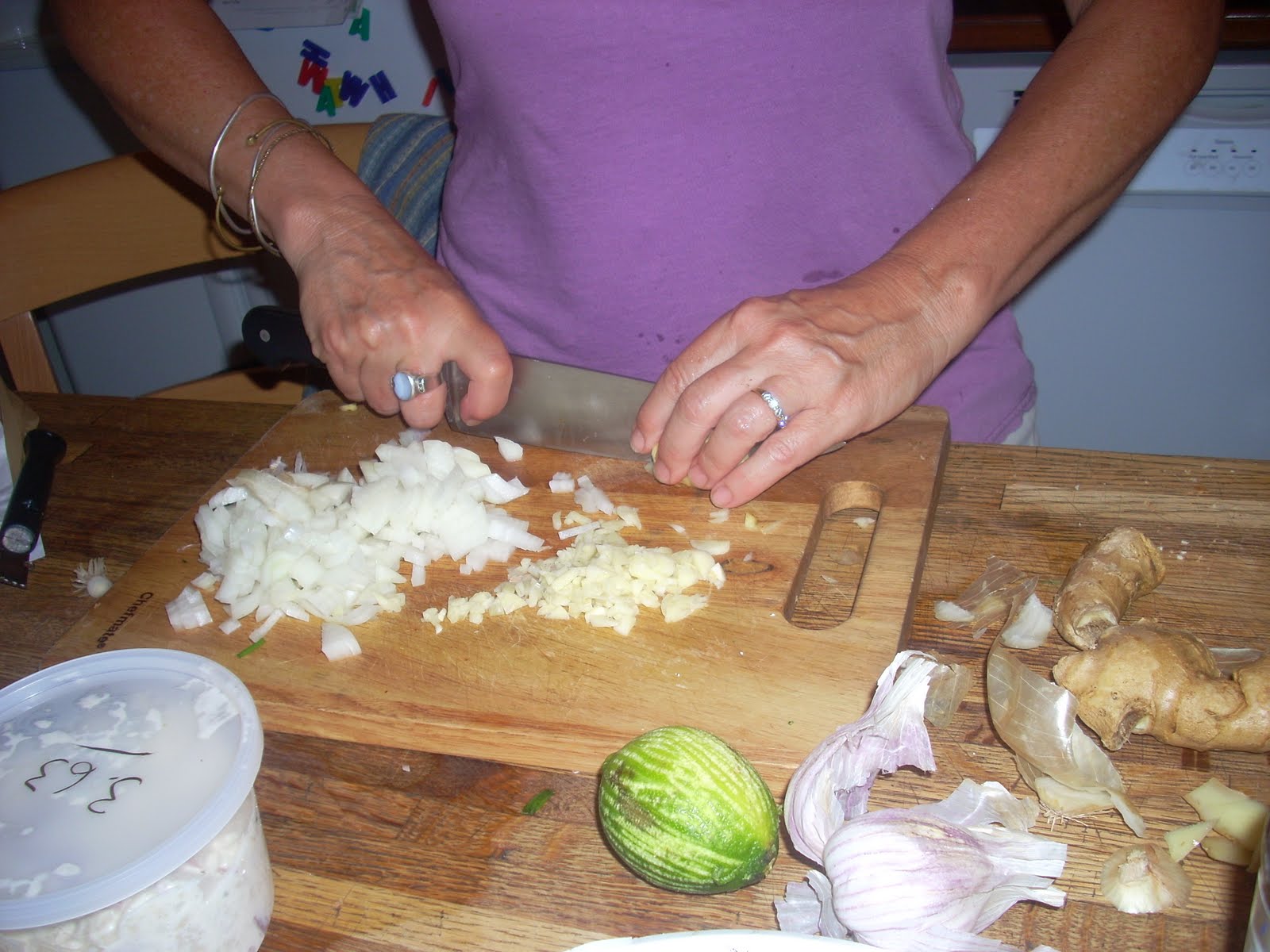
Chop up copious amounts of ginger and garlic and zest a whole lime

Stir fry the onions, garlic and ginger in Tamari sauce, brown sugar and red pepper flakes - no oil!

Add the snow peas, scallions and lime zest - Sublime - better than the band

Add noodles and tofu
Dag it's hard to squeeze a lime and snap a picture - but I'm developing mad skillz

Mie Goreng

Liam diggin' the meal
Mie Goreng - Fried Noodles
Ingredients
- 1 lb Uncooked soba noodles
- 3 tb Low-sodium soy sauce
- 1 tb Brown sugar
- 2 ts Crushed red pepper flakes
- 1 c Finely chopped onions
- 1 tb Minced garlic
- 1 tb Peeled & grated gingerroot
- 1 c Snow peas
- 6 ea Scallions, chopped
- 1 t Grated lime peel
- 1 c Mung bean sprouts
- 8 oz Firm tofu -- cut into 1/2-inch cubes
- 1 tb Fresh lime juice
- 1/4 c Chopped fresh cilantro
Directions

Final Assessment: Hot, spicy, sweet, light, imminently satisfying , full of complex flavors, clean that take you to Brunei - A++
Sunday, June 27, 2010
Day 24 - Brazil! Feijoada and Pão de queijo - Up Next, Brunei (vegetarian)
Feijoada and Pão de Queijo

Our family is blessed to have some very close, special Brazilian friends and family in our lives who frequently treat us to wonderful home cooked, traditional meals. And, while the meal I prepared tonight couldn't begin to touch the quality of their cooking, I do hope that the love and respect we feel for them and their beautiful country is conveyed in spades. We love you, Ben, Juciene,Juliane, Danielle, Anna Julia and of course, my other son, Jon.
I love technology. This is how we arrived at this meal: Ian got on his Blackberry to survey his friends. Tim got on his iPhone to check with his friends, I went to the web and texted our friend Ben...After receiving input from numerous friends and sources, I was advised to try my hand at none other than the National Dish of Brazil, the hearty Feijoada stew and Pão de queijo, cheese rolls.
This recipe takes some time to cook, (about 30 minutes to prep and 3 hours to cook), and since I didn't know what the Hell I was doing, I started at around 3 p.m. to ensure that we'd be having dinner before midnight. No pressure, though!
Oh, look! John Hiatt just happened to stop in to see what I was cooking...You know, he's on tour right now and doesn't often get a good meal - what a lovely surprise...can you sing "My Old Friend" while I chop these onions? Thanks, you're a doll.

A little aside about this meal: a few readers have suggested I include more vegetarian dishes, which I think is a great idea . I truly appreciate the constructive criticism and feedback because one never knows who, if anyone, is actually reading the stuff I ruminate about! HOWEVER....Brazil is not the country to try to go vegetarian in ... Brunei is up next, and I intend to suppress my meatatrian tendencies as promised!
 Brazil is the largest country in South America and borders every other South American country except Chile and Ecuador. From west to east it stretches nearly 2,700 miles from the Andean foothills eastward to the Atlantic Ocean. Its official name is the Federal Republic of Brazil, or, in Portuguese, the Republica Federativa do Brasil. It occupies almost half the area of South America and is the world's fifth largest country. Although just slightly smaller than the United States in area, Brazil's population is about 40% less.

Some ingredients I've never cooked with before: Almidon de Yuca (tapioca starch), queso blanco fresco (white farmer's cheese)

Roasted smoked pork sausages, linguica, pork and slab bacon - serious amounts of meat!

Seasoning: scallions, garlic, onions and spices

The stew simmering away


Pão de queijo

The final product!!

Feijoada stew http://homecooking.about.com/od/soups/r/blss168.htm
Ingredients:
- 2 cups (1 pound) black beans, rinsed and picked over
- 3/4 pound pork butt or shoulder, trimmed of fat
- 6 ounces slab bacon
- 1/2 pound smoked pork sausages
- 1/2 pound hot Portuguese sausage such as linguica
- 1 or 2 pounds ham hock or shank, cut into 1-inch rounds
- 1 large yellow onion, chopped
- 2 to 4 ounces dried beef carne seca, minced (optional; see Note)
- .
- For the Seasonings:
- 3 garlic cloves, minced and sauteed in 1 tablespoon vegetable oil
- 6 green onions, including tops, chopped
- 1 yellow onion, chopped
- Large handful of chopped fresh parsley (about 1/2 cup)
- 2 bay leaves, crumbled
- 1-1/2 tablespoons dried oregano, crushed
- Salt and ground black pepper
- Chopped fresh cilantro or parsley
Preparation:
Soak the black beans overnight in water to cover by several inches. Drain.Place the drained black beans in a saucepan and add water to cover by 3 inches. Bring to a boil, reduce the heat to low, cover, and simmer until the beans are tender, 2 to 2-1/2 hours. Add additional water as needed to keep the beans covered.
While the black beans are cooking, prepare the meats. Preheat an oven to 375 degrees F. Dice the porl butt kor shoulder and the bacon into 1/2-inch cubes. Place the pork, whole sausages, and bacon in a large baking pan. Roast until well done. The sausages will be ready after 35 to 40 minutes and the other meats after 45 to 60 minutes.
Cook the ham hock at the same time as the meats are roasting. In a saucepan, combine the ham hock rounds and onion with water to cover. Bring to a boil, reduce the heat to a simmer, and cook until tender, about 1 hour. Remove the ham hock rounds from the water and remove the meat from the bones, if desired; set aside. Or leave the rounds intact for serving alongside the black beans. Strain the cooking liquid into a bowl. Add the strained onions from the liquid to the beans. Add the cooking liquid to the beans if needed to keep them immersed.
Once the black beans are almost cooked, check to make sure there is plenty of cooking liquid in the pot. It should be rather soupy at this point. Stir in the beef carne seca. Cut the sausages into rounds and add them and all the other cooked meats to the pot. Then add all of the seasonings to the pot, including salt and pepper to taste. Simmer for another 30 minutes, or until the beans are very tender.
Taste and adjust the seasonings. Sprinkle with chopped cilantro or parsley just before serving.
NOTE: Using dried beef adds complexity to the richness of this dish, but its inclusion is optional. If dried beef isn't available at your butcher, Armour makes a ground compressed dried beef sold in 2-1/2-ounce jars. Soak it in warm water to cover for 15 minutes to rinse off some of the salt.
Yield: 8 servings
Brazil is famous for its pão de queijo - cheese rolls with soft chewy centers. Pão de queijo is made with cassava flour (tapioca flour), the ground root of the manioc plant. They smell wonderful when they are baking, and plump up into perfect round balls. Many recipes call for parmesan, but if you can find the Brazilian cheese queijo minas in your local Brazilian market, your pão de queijo will be even more authentic. Regular farmer's cheese or any other firm, fresh cows milk cheese work well in this recipe.
Pão de Queijo- http://southamericanfood.about.com/od/breads/r/paodequeijo.htm
Prep Time: 15 minutes
Cook Time: 25 minutes
Total Time: 40 minutes
Ingredients:
- 2 cups whole milk
- 8 tablespoons butter, melted
- 1/2 cup vegetable oil
- 4 1/4 cups tapioca flour
- 4 eggs
- 2 cups grated farmer's cheese, or any firm, fresh cows milk cheese
- 1/4 cup grated cheddar cheese (optional)
- salt to taste
Preparation:
- Preheat the oven to 350 degrees.
- Mix milk, salt, vegetable oil and butter in a pot, and bring to a boil. As soon as it boils, remove from heat.
- Stir tapioca flour into the milk and butter mixture.
- Stir in the eggs and the cheese, and mix well.
- Let mixture cool for 15-30 minutes, so that it will be easier to handle. (I like to chill it in the refrigerator for 15 minutes or so).
- With floured (tapioca flour) hands, shape the dough into golf ball size balls (about 50 gram portions) and place them on a baking sheet.
- Bake rolls for 20 to 25 minutes, until they are puffed up and are golden. They will rise slowly and puff up mostly in the last 5 or 10 minutes.
- Serve warm.
Final Assessment: This is very good, but very heavy food. The flavors are rich, and anything with black beans works for me. But we all agreed that a little goes a long way. The cheese rolls were great - also heavy, but totally addicting! Go for it if you have the time and want a delicious hearty meal!
Wednesday, June 23, 2010
Day 23-Botswana - Chicken and Groundnut Stew - Up Next Brazil
Bostwana Chicken and Groundnut Stew
First time trying my cast iron pot on the fire pit!!
 Buddy keeping an eye on things in the background...just in case....
Many years ago, my brother Clay (I love you, Yo) gave me a beautiful cast iron pot. The thing weighs about 7lbs and when full, takes two hands to lift. Until tonight, I haven't used it much, in fact, at one time, it held our spare change. But when I started researching how food was cooked in Botswana, I learned that stews are a national staple, and that they are often cooked in a "three legged" pot on a hot bed of coals! Yay! My sister, Anna (I love you, Gamma) suggested I include a poem she read that appears in the No. 1 Ladies Detective Agency series, which takes place in Botswana, but I couldn't find it anywhere!
After consulting with my friend John, a.k.a Sparky, I set up the cooking surface by putting several flat stones right on the grill to ensure that the bottom of the pot wouldn't burn. John suggested bricks, but I didn't have any, so I used what I had - a few flat(ish) rocks I found in the yard.
I knew I had to build a really good fire because it had to be hot enough to heat the heavy pot to simmer the stew for an hour before cooling down. I chopped up some good fire wood and collected kindling from around the yard to build a good base for the charcoal. I was advised to wear steal toe boots while chopping wood, but, well ...I admit it, I'm a chick and have chopped wood, in high heels for God sake.

The wood shed: I used a maul, 2lb. sledge hammer and hatchet to chop up nice pieces of well seasoned wood

This afternoon I built up the fire pit by adding a few more stones. I also planted a Yarrow my friend Sangeeta gave me and Tim's Bamboo for the heck of it.


The Ingredients: brown sugar, ground peanuts (I ground them in a coffee grinder), cayenne, ginger, onion, tomato paste and chicken - I asked the butcher at my local grocery store to cut up a Perdue Oven Roaster (www.perdue.com/) because I'm tired of buying scrawny, fatty chickens and it was great!!
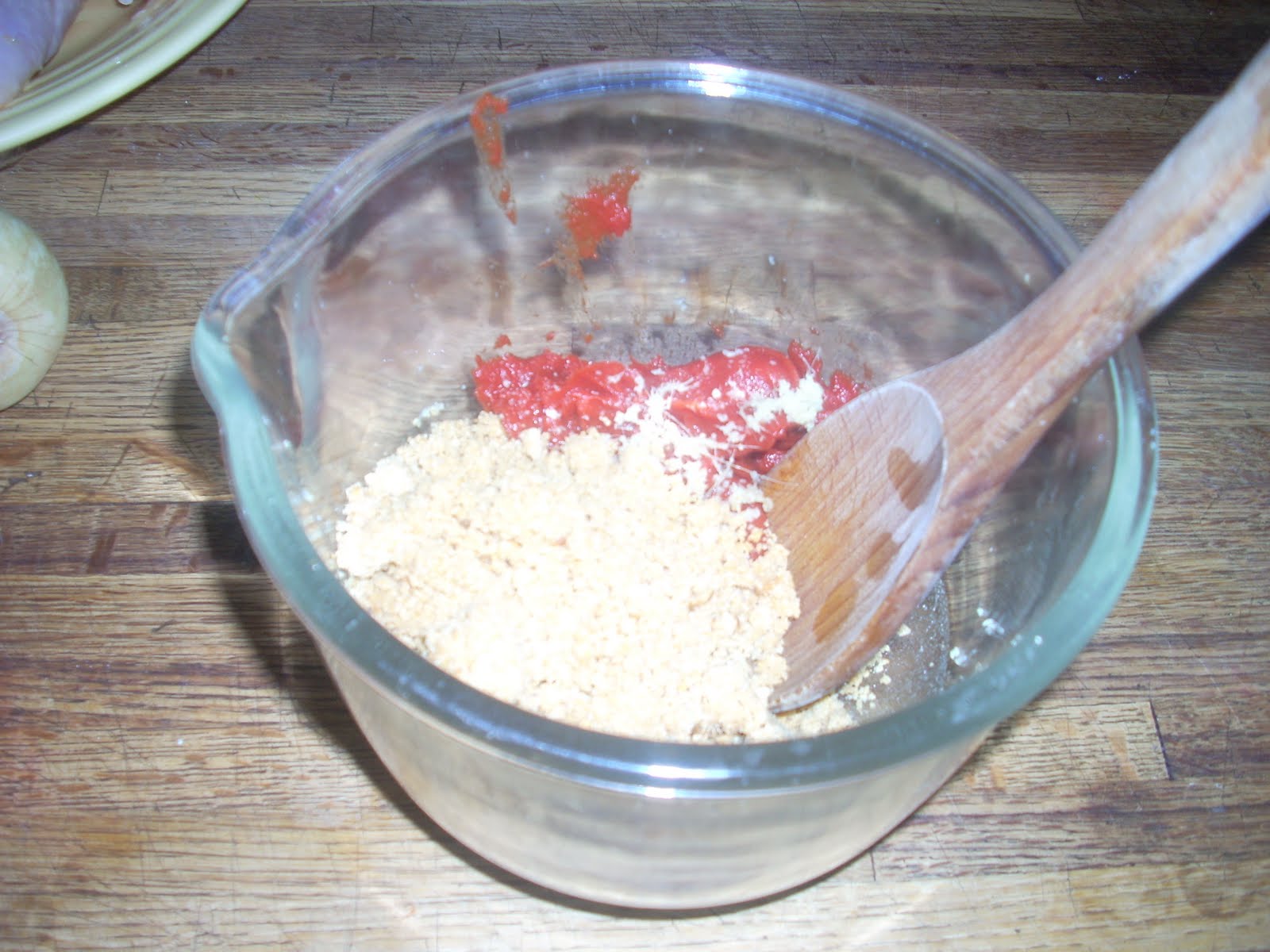
The Peanut sauce: ground peanuts, tomato paste, grated ginger, brown sugar, cayenne and water - well awright


I cooked the onions until they were translucent, added peppers and browned the chicken

When the chicken was browned, I poured on the sauce and put the lid on to let the stew simmer away for about an hour
Unbelievable - It actually works!!

Twice the size of Arizona, Botswana is in south-central Africa, bounded by Namibia, Zambia, Zimbabwe, and South Africa. Most of the country is near-desert, with the Kalahari occupying the western part of the country. The earliest inhabitants of the region were the San, who were followed by the Tswana. About half the country today is ethnic Tswana. The term for the country's people, Batswana, refers to national rather than ethnic origin.


I picked lettuce and herbs from my garden for the salad

Voila: Chicken Groundnut Stew, Rice and Green Salad, eaten outside because it's too hot in the house and there's something about eating outside that makes everything taste better.
The Recipe
Botswana Chicken Groundnut Stew
- Chicken, cut up
- 1 Tbsp vegetable oil 1 med onion, chopped
- 1 green pepper, chopped
- 1 Cup water
- 1/2 Cup peanut butter
- 1 4oz can tomato paste
- 1 tsp grated fresh ginger root
- 2 Tbsp brown sugar
- 1/8 tsp ground red pepper
First, prepare the peanut sauce: in a bowl, combine the sugar, red pepper, ginger, peanut butter, and tomato paste. Slowly stir in the water, a small amount at a time, until the sauce is smooth. Set aside.
Heat the oil in a large pot over medium heat. Add the chopped onion, cooking 5-7 minutes until onion is translucent. Add cut-up chicken and green pepper. Cook until the chicken and the onion are brown and the green pepper is soft. Pour the peanut sauce over the browned chicken, peppers and onions and stir well. Cover the pot and and reduce heat to low. Simmer, covered, for 1 hour, stirring occasionally.
To serve, spoon servings of Groundnut Stew over Rice Balls, or on a bed of white rice.
Rice Balls
- 1 Cup short grain rice
- 3 1/2 Cups water
- 1 tsp salt
Cook rice according to directions on package. When rice is cooked, use a potato masher or fork to mash the rice until it begins to clump together. Wet your hands with cold water, and taking a clump of rice in your hands, form it into a ball. Place rice balls on a serving platter or individual plates.
Traditionally served with soup or stew, which is spooned over the rice.
My in-house food critics, Tim and his best friend, Mac - diggin' the stew!

Final Assessment: I loved this meal and I loved cooking it on the fire. The flavors were rich and had that taste that only food cooked on wood and charcoal takes on. I'd make this again any day. Of all the meals I've prepared, those from Africa and the Caribbean countries have been my favorites.
Subscribe to:
Posts (Atom)