-->

Friday, April 15, 2011

Day 124! New Zealand - Liquored Pork with Apricots and Capers & Kumara Orange Mash - Up Next, Nicaragua


Tonight's New Zealand dinner is made possible by my old (figuratively speaking) and awesome friend, Sonny, who picked this book up for me while on assignment in New Zealand. Many, many thanks to you for taking time out of your busy schedule to hunt this beautiful book down for my wacky journey!

This cook book includes some of the best recipes from chefs throughout the country, but I tried to pick a dish that would capture the feel of the country and still be easy enough to replicate without having to fly there to find the ingredients. Tonight's meal comes Central Otago and Queenstown, on the tip of the South Island.

Located in the south-western Pacific Ocean, New Zealand is made up of north and south land mass islands. Because the country is one of the most remote in the world, it was one of the last to be settled by humans. Inhabitants on the island are primarily of European descent, the indigenousness Maori being the largest minority, followed by Asian and Polynesians.

Cuisine varies by location, but agriculture is the primary source that sustains New Zealand. Local produce, sea food and live stock are abundant, with British-based with Mediterranean and Pacific Rim traditions infusing the culture.


Liquored Pork with Apricots and Capers (Adapted from the Discover New Zealand Food Cookbook)

4 large pork chops
1 Tbsp. oil
1/2 cup brandy
1 cup orange juice
1/4 cup Kahlua (I used the homemade stuff I made!)
1/2 cup dried apricots, roughly chopped
zest of 1 orange
1/2 cup capers
1/4 cup walnuts or hazelnuts
1/2 cup cream
salt and freshly ground pepper to taste

Heat the oil in a hot frying pan and brown the chops on both sides. Remove to an oven proof dish. Degalze the pan with brandy then orange juice. Turn down the heat and add the kahlua, the apricots and organge zest. Pour over the pork chops, cover and bake in moderate oven for 30 minutes. Add the capers, walnuts and cream. Season and bake for a further 10 minutes, uncovered.
Serve with a green salad and kumara orange mash.

Kumara Orange Mash (sweet potatoes) (Adapted from allrecipes.com)

2 lbs (about 4) sweet potatoes, peeled and cut into 4-5 inch chunks
1-1/4 cups fresh orange juice
1 Tbsp. grated fresh ginger
1 garlic cloves, crushed
2 tsp. butter
salt and pepper to taste

Place the sweet potatoes in a large saucepan, add enough water to cover and bring to a boil. Reduce heat to medium, over and simmer until the sweet potatoes are tender, 10-12 minutes.

Meanwhile, combine the orange juice, ginger and garlic in a small sauce pan and bring to a boil. Reduce the heat to medium and simmer, uncovered, until he juice is reduced to 3/4 cup, 5 to 8 minutes. Remove from the heat, add the butter and stir until melted.

When the sweet potatoes are tender, drain them and return to the saucepan. mash with a potato masher. Gradually add the reduced orange juice mixture, stirring with a wooden spoon. Season with pepper.

Final Assessment: My family loved this meal because the sauce was sweet and loaded with citrus flavor. The combination of brandy and Kahlua made a wonderful glaze and the addition of the capers, cream and apricots was just awesome-sauce. Served up along side Kumara Orange Mash (sweet potatoes) and a fresh green salad, the meal was a winner.

Wednesday, April 13, 2011

Day 123! Netherlands - Knolselderijstamppot (Celeriac Root Mash) Up Next,New Zealand


Recently, I got some very generous advice from Jeff kauck, internationally acclaimed food photographer whose work I discovered after reading an article in Popular Photography. After exchanging a few emails and looking at my photographs, Jeff encouraged me to work using only existing light. Now I haven't used a flash  for a long time, but I do have my kitchen lights on when I photograph the meals I make. By turning them off, putting my camera on a tripod and shooting with just the existing light from the north facing window over my counter, I could achieve the true colors and beauty of the food without the orange glow caused by tungsten lights.  So, these pictures are shot that way (except for one). The hardest part was getting used to using my trip-pod, since I'm used to contorting myself to get different angles. Practice, practice and more practice. It's so exciting to try new things and see where they take me. Which tonight, is to the Netherlands.

A constituent country of the Kingdom of the Netherlands, known in it's entirety as Holland,  the country is located in north-west Europe, with parts in the Caribbean. The country borders the North Sea, Belgium and Germany. Both the people and their language are referred to as Dutch. In 2010, the the BES Islands, Caribbean Netherlands became part of the the Netherlands after the dissolution of Netherlands Antilles.

Much Dutch cuisine is closely related to French culinary traditions, but also has it's own unique culture. Fishing, farming, agriculture and raising domesticated animals are all common to the culture. Depending on the region, the food varies somewhat. To the north-east, meat and game, sausages, cheese and pastry are common. Coastal regions rely on seafood as their source of protein, while to the west and south, dairy, cheese, rich pastry, butter and cream can all be found.

Stampoot is a traditional Dutch dish that is usually made of potatoes and any other vegetable that happens to be available. I used celeriac root because I love the taste and don't often cook with it (although I think I will now). I served it with roasted lamb and steamed spinach.


Knolselderijstamppot (Celeriac Root Mash) - (Adapted from dutchfood.com)

6 large mealy potatoes, like Idaho or russet potatoes
1 large celeriac
1 cup chopped celery leaves
3 Tbsp butter (or to taste)
2 Tbsp. coarse brown mustard
Salt and pepper to taste

Peel the potatoes. Peel the celeriac using a knife to cut the thick skin away until you are left with only creamy white flesh. Cut the potatoes and celeriac into similarly sized pieces for even cooking. In a large pot, boil the potatoes and the celeriac for 20 minutes in salted water until tender. Drain thoroughly and mash with a potato masher or ricer. Add the butter and mustard and season to taste. Stir through the celery leaves just before serving.
Serve as side dish, or top with smoked pork sausage and gravy as the main course.

Sunday, April 10, 2011

Day 122.5 - Tim's Homemade WTF Chicken Nuggets


Text from my son Tim last night:

Tim: mom wts 4 supper?
Me: Nepalese - eggplant thingie
Tim: WTF?? Y cnt u mk sumfin gd!
Me: such as?
Tim: chkin ngts

So there you have it. I am not making this up. Seriously, my kids could request almost any dish from any country and I would try to make it. But nooooooo, Tim wanted chicken nuggets. Not only that, he didn't want the ready-made frozen "chicken" from our freezer. No, he wanted me to make them.

But, before I get into the recipe, a shout out to my friends Lucy and  Richard for their academic input (via a lively Facebook discussion) as to the actual origin of chicken nuggets. They tell me that chicken nuggets were first discovered in the little country of Whathefucovia. Unique to this country, chicken nugget plants are grown and their nuggets exported by the Chicken Nugget Exporting Council (CNEC) which is administered by the U.N. Food Security Council. So, now you know where that bag of chicken nuggets in your freezer comes from. By the way, a quick ingredient count on the bag (whose brand shall remain nameless for fear of nugget lawyers slapping me with a defamation lawsuit) yielded 36 ingredients, many of which I cannot pronounce.

Now for the actual production of homemade chicken nuggets. There were several recipes online, but none of them had all the ingredients I taste when I swipe one off my kid's plate, hot 'n fresh from the microwave. The best one I found is from the awesome blog Soupbelly, from which mine is adapted. And, yes, they are fried, but, you know, WTF, sometimes you just HAVE to have something fried and these are just the ticket.


Homemade Chicken Nuggets (aka, Tim's WTF Chicken Nuggets - Adapted from Soupbelly)

2 lbs. chicken (1 lb. white meat and 1 lb. dark meat)
1 tsp. salt
1 Tbsp. fresh chopped parley
1/2 tsp. onion powder
1/2 tsp. garlic powder
1/4 tsp. sugar
1/2 tsp. paprika
1/4 tsp. pepper
2 eggs, beaten
1 cup flour, seasoned with 1 tsp. salt
2 cups canola oil for frying

Heat oil in a heavy skillet on medium high heat as you're preparing the chicken nuggets. The oil should be very hot, but not smoking.

Cube chicken and place in the food processor along with all the spices. Run the processor until the meat and spices are completely blended and a paste is formed.

Combine 1 tsp. salt and flour on plate. Next, beat eggs in another bowl.

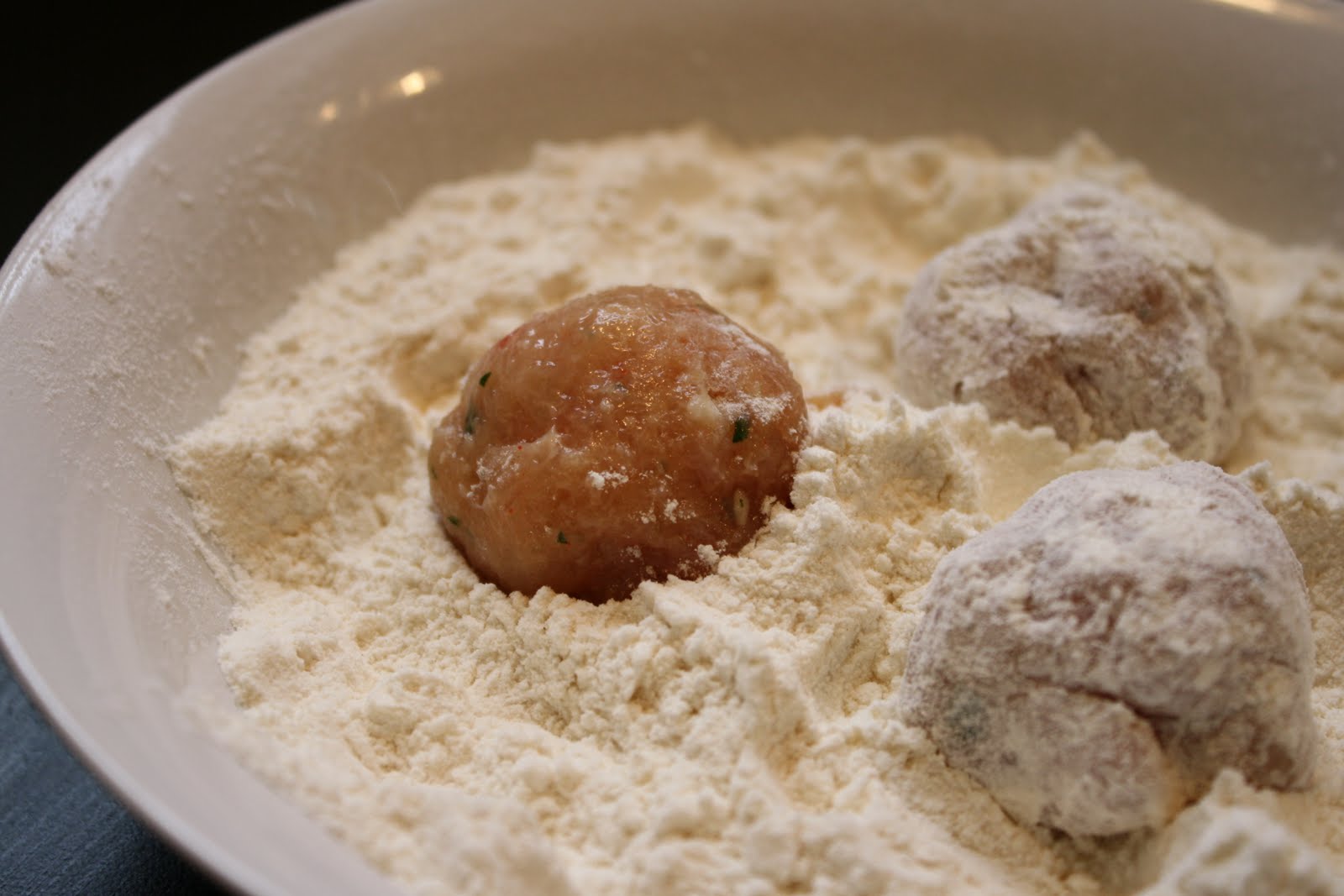
Scoop about a tablespoon full of chicken paste up and form it into a ball about the size of a ping pong ball. Next, roll in the flour, then dip into the egg then in the flour again, shaking off any excess flour.
Press the ball down to form a nugget shape. Set aside and continue until all are done. You should have about 35-40 when you're done.

Place nuggets in oil, taking care not to overcrowd the pan. Fry until the bottoms are golden, then flip to continue cooking until the nuggets are golden brown. This will take about 4-5 minutes per side.
Drain on a cookie sheet lined with paper towels.

Final Assessment: Oh, wow. Tasty, crispy, full of  flavor and fried deliciousness. Dip 'em in catsup Once you make these, you'll never go back. 

Saturday, April 9, 2011

Day 122! Nepal Eggplant Bhutuwa with Roasted Tomato Achar (Vegetarian) - Up Next, Netherlands


Yikes! My hands are on fire from seeding and chopping copious amounts of flaming hot red chili peppers for this Nepalese Eggplant Bhutuwa and Roasted Tomato Achar meal. If I hadn't been multi-tasking to the max, I might have thought to wear gloves but it's way too late now. Note to self:  wash hands really, really, really well before removing contacts tonight.

Located in the Himalayas of south Asia, Nepal is a landlocked country bordered by China and India. The country's rich geography boasts 8 of the world's 10 tallest mountains, including the highest point on earth, Mount Everest (or Sagarmatha in Nepali). In the southern regions of the country, the climate is humid and the soil fertile, drawing people to it's more urban environment. More than any other country in the world, Hinduism is practiced in Nepal. Buddhism, although a minority faith in Nepal, is intrinsic to the country's culture and belief system. Historically ruled by a monarchy, Nepal established a democratic republic in 2005 after a decade long civil war.

Just as the climate, geography and cultures are diverse in Nepal, so too is the cuisine, but Dal-bhat-tarkari (cooked or steamed rice and lentil soup) is eaten through-out the country. In higher elevations where rice doesn't grow as well, maize, buckwheat, barley, millet, roti or chapati are eaten. Finally, condiments in the form of small amounts of very spicy chutney or achar, lemons, limes and chili peppers accompany most meals. Vegetables eaten include: spinach, daikon radish, potatoes, tomatoes and cauliflower. Goat, chicken, water buffalo and fish are eaten, but beef is forbidden.


Eggplant Bhutuwa (Adapted from Explore Nepal)

5 cups eggplant, cut into 1-inch pieces
2 cups potatoes, sliced
1 cup tomatoes, chopped
1 cup green onion, cut into 1-inch pieces
5 dried whole chilies
1 tsp. cumin seeds
1 Tbsp. garlic, minced
1 Tbsp. ginger, minced
1 Tbsp. red chillies, minced
1 tsp. ground black pepper
1 tsp. turmeric
1 cup broth or water
1/4 cup cooking oil
Salt and pepper to taste
2 Tbsp. chopped cilantro for garnish

In a large pot of salted boiling water, blanch eggplant for a couple of minutes and transfer to ice bath.
In non-stick saute pan or wok, heat oil and ry dried whole chilies and cumin until dark.
Add potato slices, turmeric, salt, and pepper and stir-fry until potatoes are well browned and cooked half way.
Add garlic, ginger and chilies. Mix well to incorporate into the potatoes. Add blanched eggplant, broth and salt and pepper.; stir fry for 5-7 mintues over medium-low heat until potatoes and eggplant are tender.
Add diced tomtoes and green onions just before removing from heat.
Garnish with chopped cilantro. Serve hot with basmati rice topped with Tomato Achar


Roasted Tomato Achar (Adapted from 43things.com)

4 large ripe tomatoes
5 fresh hot red chilies, minced
1 Tbsp. garlic, minced
1 Tbsp. ginger, minced
1 tsp. coriander
1 tsp. cumin seeds
1 Tbsp. mustard seeds
2 Tbsp. cilantro, chopped
1 Tbsp. mint leaves, chopped (optional)
1 Tbsp. cooking oil
Salt to taste

Garnish
1 Tbsp. oil
1 tsp. fenugreek
10 cloves garlic, thinly sliced
2 Tbsp. chopped green onions

Preheat oven to 425 F
Cut tomatoes in half and place cut side down on cookie sheet. Brush lightly with olive oil.
Roast in oven for 30 minutes, or until skin is charred.
Remove charred skin and reserve flesh in a bowl.
In a sauce pan, heat oil. Add cumin and mustard seeds; fry for 30 seconds.
Add chilies, garlic, ginger, coriander, lime juice and salt; stir for a minute.
In a blender, combine roasted tomatoes, chopped cilantro and mint and spice mixture; process to for a smooth mixture - or, leave slightly chunkier texture if desired.

For garnish, in a non-stick pan, heat one tablespoon of oil and saute fenugreek until it turns dark. Add slices of garlic and fry till light brown. Pour the garlic-oil mixture and chopped green onion over tomato mixture.
Mix well and refrigerate for at least two hours before serving.

Final Assessment: This was a delicious, beautifully scented and colorful meal. It's very hot, so if you can't take the heat of tons of garlic, ginger and red hot chili peppers, you may want scale back the proportions to make a milder version. Regardless, this dish is both satisfying and filling. Served along side basmati rice and roti, this Nepalese meal will not disappoint even the most die hard meatatarians.