-->

Tuesday, October 23, 2012

Favorite Things Victoria's Kitchen Almond Water


I first encountered Victoria's Kitchen almond water at the Winter Fancy Food Show this past January. I was struck by how refreshing it was. It's not creamy like almond milk, but thinner and lighter and not too sweet. It has no artificial flavors or colors and while the way it is made is a secret, it's ingredients are only  water, sugar, natural almond flavor (whatever that is!) and citric acid. There's something almost dewy about it. I really like it. So when I had the opportunity to receive some samples I said "yes." I thought I'd play around with it and see if I could develop some mixed drinks. 

Let the record show, I am not a bartender. Not even close. I think it's part of the reason I am so in awe of bartenders. They are like alchemists, balancing flavors in ways that amaze me They delight  me with their concotions. I tried pairing almond water with rum, bourbon, orange liquor, gin and even coffee liquor. Did I mention I am not a bartender? 

I can tell you that almond water is fantastic in hot cocoa, and in warm and cold milk. It has some real affinities with rum, but you'd have to be adept at creating drinks to come up with the right cocktail using it. There are some sophisticated cocktail recipes on the Victoria's Kitchen almond water web site. It's not a very expensive mixer and it's delicious both hot and cold. You can also find a store locator

Monday, October 22, 2012

Cilantro and Lime Fried Egg on Toast


Fate intervened.   Had I not been compelled to move the tupperware container sitting on a shelf in the fridge, I would not have spied the sad looking plastic bag behind it.  But I did move it!  I did!  And since then, our breakfasts have taken a delicious turn.  The lucky find was cilantro, an herb that was used days before and then quickly forgotten.  So that morning, I made eggs over easy with toast, some spices/herbs, and then a generous dusting of cilantro.  It was good, but we decided that the sourdough bread needed to be bronzed on a skillet in order to be easier to eat (plus, you know, more fat and deliciousness).  So the next day we did the bronzing with the same herbs and spices and the cilantro.  Then I wondered what would happen with a drizzle of lime juice, so the next day, we did the bronzing, the herbs and spices, cilantro... and the lime juice.  Harmony.  Seriously, what an unexpectedly awesome combination.

I can't bear to think what would have happened had I not moved that container when I did.  Instead of a wonderful new breakfast, a slimy green mess would have been found...  then tossed.

Ingredients 
chopped cilantro
eggs
oregano
kosher salt
crushed red pepper
cumin
garlic powder
slices of sourdough bread
extra virgin olive oil
lime wedges

Instructions
Heat olive oil in cast iron skillet.  Place the slices of sourdough bread on the griddle and bronze each side.  Take off heat once both sides have browned.  Set aside.  Pour in more olive oil if needed.  Crack the eggs into the hot skillet.  Sprinkle with oregano, salt, pepper, cumin, and garlic powder.  Once the white looks pretty cooked (about a minute), get the spatula (be sure to get it underneath the yolk) and flip the whole thing to finish cooking (over easy).  It should only take a few seconds.  Then place on bronzed toast.  Cover with a healthy sprinkling of cilantro.  Serve with lime wedges.  

Thursday, October 18, 2012

Butternut Squash and Apple Risotto


The butter had been melted.  The shallot had been added, and was wonderfully soft.  The rosemary and sage gave off their woodsy scents.  Garlic was emitting its pungent fragrance.  It was time to add the rice.  So I measured out the rice and stirred it into the onion and butter mixture, letting the rice get all toasty in a quick herbal butter bath before adding the white wine.

Then I noticed something strange.  I had poured in long-grain brown rice?  How did this even get into the cupboard, let alone get into my pan?  I must have purchased it up by mistake.  Do not make the same mistake I did.  I gave it a chance, trying to cook it for a bit, praying that somehow a risotto would force its way out of this mixture.  A risotto did not emerge.  I guess it could have, if I had given it about a year to cook.  So yeah, do not mistakenly grab long-grain brown rice at the grocery store than grab it from your cupboard to make risotto.

I had to restart the whole thing, of course.

Ingredients 
2 tablespoons unsalted butter
1 large shallot, chopped
2 garlic cloves, minced
1 sprig rosemary, needles removed and chopped
1 tablespoon chopped sage leaves, plus more for garnish
1 1/2 cups Arborio or medium-grain rice
smoked sea salt, to taste
ground white pepper, to taste
1/2 cup dry white wine
6 cups chicken stock
1 1/2 cups butternut squash puree
2 Granny Smith apples, cored
1/2 cup toasted pinenuts, for garnish

Note: I roasted a whole butternut squash in a 425 degree oven for about 90 minutes to 2 hours, then scooped out the seeds and stringy parts and ran the flesh through a food processor.
To toast the pinenuts, I place in a dry skillet over medium high heat and toss until they have developed a golden brown color (about 4 minutes).  

Instructions 
In a medium pot over medium heat, keep the chicken broth warm.  Melt butter in a large saute pan.  Add the shallot, rosemary, and sage.  Once the onion has softened (about 4 minutes), add the garlic and cook for about 30 seconds, til fragrant.  Add the rice.  Stir the rice and let the butter coat the rice.  Sprinkle a bit of salt and pepper.  Pour in the white wine and stir the rice.  Once the rice has absorbed the wine, add in a ladleful (about 2/3 cup) of chicken stock.  Stir and let the rice absorb the stock.  Once it has absorbed it, add the next ladleful, and keep repeating.  Be sure to stir frequently.  Once the rice has cooked, stir in butternut squash puree.  Grate the apples into the risotto and stir.  Top with toasted pinenuts.

The Epicurious Cookbook & MyRecipes America's Favorite Recipes


Despite the popularity of recipe websites, we enjoy printed cookbooks too much to dismiss them. Fortunately two big website publishers have compiled cookbooks that are truly stellar in some ways marrying the best of both worlds. They not only share their top rated recipes, but give use quotes and tips from readers and reviewers. The result is cherry picked recipes with plenty of reader insight. 


The Epicurious Cookbook has over 250 "four fork" recipes that are tried and true. There are plenty of photographs, though not for every single recipe. The recipes are from magazines including Gourmet and Bon Appetit, as well as members. The headnotes for the recipes are particularly helpful, making serving, storage, and even substitution suggestions. The recipes have a certain practicality to them, as the back cover says "recipes you'll make again and again." There are also recipes from beloved chefs like Dorie Greenspan, Alfred Portale and Tom Colicchio. The photography is often elegant and have a consistent style (yes, more weathered wood finished backgrounds...) I love the sound of Eggplant Lasagna with Parsley Pesto, Beet and Carrot Pancakes and Mahogany Chicken (glazed in a soy, mirin and ginger sauce). The only thing I don't like about this book? The recipes are organized seasonally. Calling granola a Winter breakfast just seems dumb to me. There is no good reason not to make it and eat it all year long. Perhaps in some parts of the country this is helpful, but not in California where seasons overlap and are not always so distinct. 


MyRecipes America's Favorite Food culls recipes from magazines including CookingLight, RealSimple and Sunset. It has 200 recipes all highly rated and tested. If you are the kind of person who prefers photos with every recipe, you will be happy with this book. If you are the kind of person who likes to read helpful headnotes, you will be disappointed, because there are none. There are some tips now and again, but more often there are symbols prompting you to scan a photo with your smart phone. Once you do that, you might get more recipes or a technique video. I'm a little bewildered. I use my phone for recipes, but not while I am reading a cookbook. It's an attempt to "bridge the digital divide" but frankly, it seems a little gimmicky to me.  I like that they tell you where the recipes come from, something the Epicurious book does not do. Recipes that peaked my interest include Brandied Cranberry Short Rib Stew, Pasta with Asparagus, Pancetta, and Pine Nuts and Red Lentil Rice Cakes with Simple Tomato Salsa. 

Both of these books have really great recipes, so which one is right for you? It depends on where you generally turn for recipes. I actually think the Epicurious book has more interesting vegetarian recipes and more creative recipes in general, and the MyRecipes book has more healthy options. I've bookmarked more in the Epicurious cookbook but that's not surprising since it's my go-to recipe site. Have you seen these books yet? Let me know which one you like best. 

Monday, October 15, 2012

Washington Apples


Do apples taste better today than they used to? I was just in Washington where 65% of the fresh apples eaten in the US are grown and I learned that the varieties and growing techniques are constantly evolving. The apple trees I imagined I'd see were big bushy ones, tall and majestic growing in a fertile valley. But that's not at all what I discovered in Eastern Washington. After driving hours through sagebrush desert I got a chance to walk through the apple orchards being grown by Zirkle fruit, a fifth generation family farm operation whose fruit is distributed by Rainier Fruit. 


These days, the apple trees in Washington are grown mostly on dwarf root stock, and using V shaped trellises. This makes them much easier for picking and  for increasing the production per acre. The trees are short and bushy and most were positively laden with huge clusters of fruit.

Apples also must be cross fertilized and crab apples are particularly good for this, so you'll see them amongst the orchards too.

You may have noticed that some newer varieties like the Honeycrisp are more expensive than others, but I learned it's due to the tender love and care needed to grow them. They are delicate and even the stems must be trimmed so they don't puncture the fruit. There is no mechanical picking of apples, not yet anyway and picking apples takes skill. Recent immigration laws have made it tougher for guest workers to come to the US to pick fruit. Growers like Zirkle are having a harder time finding people to work in the fields during harvest.

In and around Yakima you'll see a great variety of crops--hops, asparagus, mint, cherries, wheat and corn in addition to apples.

Agriculture is recent in this part of the country, dating back to the 1910's and booming in the 40's and 50's.

What also makes for great apples? Some of the same things that make for great wine. The region experiences cold nights and hot days, and has dark volcanic rock and sandy, silty, loamy soils that are low in nutrients but have good drainage and plenty of water from the Cascades. Growers learn from their experiments and their mistakes. New techniques, new varieties and even new ways to store apples mean today's apples may taste even better than the one's you remember from years ago. 


I spoke at length with the growers about organic apples. They told me they use less and less pesticides and the ones they do use are very targeted and dissipate quickly. Because they also grow organic fruit, they have adopted many organic techniques that they use with their conventionally grown crops as well. I was also told that there are very few insects that they can't battle naturally these days. Fruit is tested monthly to make sure their apples are not being tainted by chemicals, such as pesticide drifts. They take issue with the research done for the EWG list of "dirty dozen" fruit that says apples have higher rates of chemical residue. They pointed me to a web site funded by both conventional and organic farmers, that shares what they consider more accurate information on pesticides

The most interesting thing I learned about apples, is that they benefit from controlled atmospheric or cold storage. Some are better after being stored than they are right off the tree! When you bring apples home, be sure to store them in the refrigerator and don't think of apples as just an autumn fruit, some like the Swiss bred Junami won't come to market until January. My favorite varieties are the spicy Braeburn, the sweet  Lady Alice and the exquisite Honeycrisp, but I look forward to enjoying the juicy Jazz apple and the tangy Pink Lady as they arrive in the markets this autumn and beyond...and cooking with them too! 

Disclaimer: I was a guest of Rainier Fruit on this trip to Washington. I was not paid to write this or any other post. 

Sunday, October 14, 2012

Kale Pesto Breakfast Pasta


The wise Dr. Seuss asks "Did you ever fly a kite in bed? Did you ever walk with ten cats on your head? Did you ever milk this kind of cow?"  He then goes on to say, "If you never did, you should.  These things are fun and fun is good."

I totally agree - fun is good.  I have yet to fly a kite in bed, walk with ten cats on my head, or milk any cow (though, i remain skeptical that walking with ten cats on your head could be considered fun, as I'm pretty sure the result would be a flurry of biting and scratching).  But we did have pasta for breakfast. And that was fun.  Therefore it was good!

I worry that it appears that we have a kale obsession.  This is not the case.  I promise!  I just happened to have a ridiculous amount of the stuff around and wanted to use it up.  So I made this.

Ingredients 
For the pesto:
3 cloves garlic
1/2 cup toasted walnuts
4 cups chopped kale
1/2 cup olive oil
zest and juice from 1 lemon
smoked sea salt, to taste
freshly ground black pepper

For the breakfast bowls:
kale pesto (about 2 tablespoons per bowl) (I made this night before I wanted to use it)
cooked spaghetti (I cooked it the night before to help speed things along for the morning, you probably want about 1/2 cup -1 cup per bowl)
egg yolks (1 per bowl)
slices of bacon (1 per bowl)
chopped parsley (about a tablespoon per bowl)
grated Parmesan (about a tablespoon per bowl)

Instructions
To make the pesto, place garlic, walnuts, lemon zest, and kale in the bowl of a food processor.  Pulse.  Slowly pour in the olive oil and lemon juice while the food processor is still running.  Adjust salt and pepper to taste, then refrigerate.

Place cooked and heated pasta in each serving bowl.   

Fry up bacon slices on a griddle over medium heat.  Once both sides have crisped, remove from griddle and place on a paper towel.  Chop.  In a skillet (I used my trusty cast iron skillet) over medium heat, fry the egg yolk.  It will only take about 30 seconds to a minute.  You want it to be warm, but still runny.   

For each bowl, toss the pasta with the pesto.  Then top with fried egg yolk, chopped bacon, chopped parsley, and grated Parmesan.


Saturday, October 13, 2012

Chocolate Reviews

It's the time of year when the Bay Area is enjoying the most glorious sunny weather and the rest of country is starting to feel the chill. While I love Indian Summer, I also look forward to all the wonderful chocolate that reappears right around now. I'm off to judge some chocolate tomorrow for the Good Food Awards, so I figured I better clear the decks today. Here's a rundown of the chocolate in my stash at the moment. 

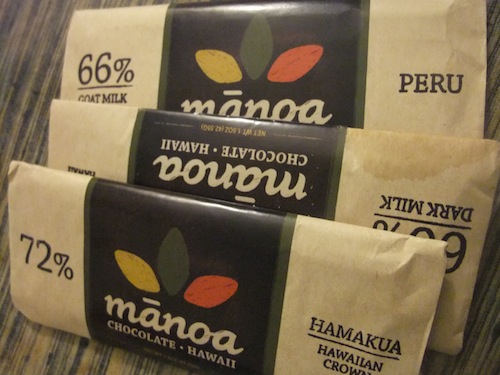
Manoa Chocolate is a bean to bar producer, crafting bars from chocolate grown in Hawaii and from Peru. Thanks to a good friend ( aren't friends who give you chocolate the best?) I got to try three bars. They are all unadulterated, made from only cocoa nibs, sugar and cocoa butter. I'm very impressed by the bars balance of sweetness and extremely creamy texture. They are well worth seeking out

The 66% goat milk from Peru has a definite "goat's milk" flavor. I like it, but you have to like goat's milk. The chocolate has a toasty character. 

The 60% dark milk from Waiahole, Hawaii bar is sweet, with a smoky flavor and a dry finish. I really like it a lot. 

The 72% Hamakua, Hawaiian crown is very unusual. I get bitter orange, and a lovely smoothness. Very intense. 

Askinosie is a chocolate maker with a social mission. I think their chocolate is good, but it's not my ideal. I prefer creamier texture and better balance of flavors and sweetness. 

The Dark Milk with Sea Salt has a very mild saltiness, almost not perceptible, it's also very floral. It's a little bit crumbly, not quite as smooth as I prefer. 

The 70% dark chocolate San Jose Del Tambo Equador has a very tannic dry profile with both floral and tobacco notes.

The 72% Tenende, Tanzania Dark Chocolate Bar is actually very mild, and has some notes of red fruit. 


I am always curious to try chocolate from Vosges. I greatly admire the creativity of the Katrina Markoff the founder and chocolatier. But I don't always love her chocolate. Sometimes it works other times, it just doesn't. Vosges is definitely not in the "unadulterated" category, their chocolates often feature edgy flavor combinations (and brilliant marketing). 

The Wild Ophelia line has eight different flavored bars. They are priced competitively and available widely from retailers including at Whole Foods. 

The milk chocolate Peanut Butter and Banana bar was my favorite. It has a tiny bit of salty crunch and the peanut butter and banana flavors really complement the sweet milky chocolate. It tastes like snack time in preschool, and I mean that in a good way.

The Sweet Cherry Pecan milk chocolate bar is definitely a bar I would enjoy again. It has lovely caramel notes and the faint chew of dried cherry. Not much pecan really. 

The New Orleans dark chocolate chili bar is pretty good, if you like fruity chili in your chocolate I guess. A little of this goes a long way. The heat packs a punch. 

The Southern Hibiscus peach milk chocolate bar is a little odd, it has the crunch of perhaps dried peaches? It's a bit sour from the fruit, but overly sweet at the same time. 

Least successful for me anyway is the Beef Jerky milk chocolate bar. It's very smoky and salty and has an "I dare you" novelty appeal but it's not something I'd want to eat again. 

Vosges also has an exotic line of bars. 

The Crispy Carrot bar is really fun. The sweetness of the carrots plays off the creamy milk chocolate nicely. The crunchy carrots will stick in your teeth though! The orange flavor is light, the carrots are more pronounced. Surprisingly good. 

The Red Fire Caramel bar is filled with creamy caramel with spicy chiles and cinnamon. It's pretty good, but rather  sweet for a 62% bar. Definitely for caramel lovers only.

The Smoked Banana Caramel bar is frankly terrible. It is another filled bar, but the smoked banana caramel has an over ripe banana flavor and is sickly sweet. I can't imagine how anyone would like this one. 

Disclaimer: These bars were samples or gifts. I was not paid to review any of them and my opinions are my own.